

compost kitchen bags: The Secret to Effortless, Mess-Free Composting
Are you ready to make a real, tangible difference from your own kitchen? It all starts with one surprisingly simple tool: the right compost kitchen bag. Forget what you think you know—these aren’t just green-tinted plastic bags. They are your secret weapon, specifically engineered to break down right alongside your food scraps, transforming everyday kitchen waste into black gold for the soil.
Choosing the right bag isn't just a detail; it's the most critical first step you can take. It’s what elevates composting from a messy chore into a clean, effortless habit. This is your ticket to radically reducing your landfill waste and actively participating in a healthier planet.
Your Simple Start to a Smarter Kitchen
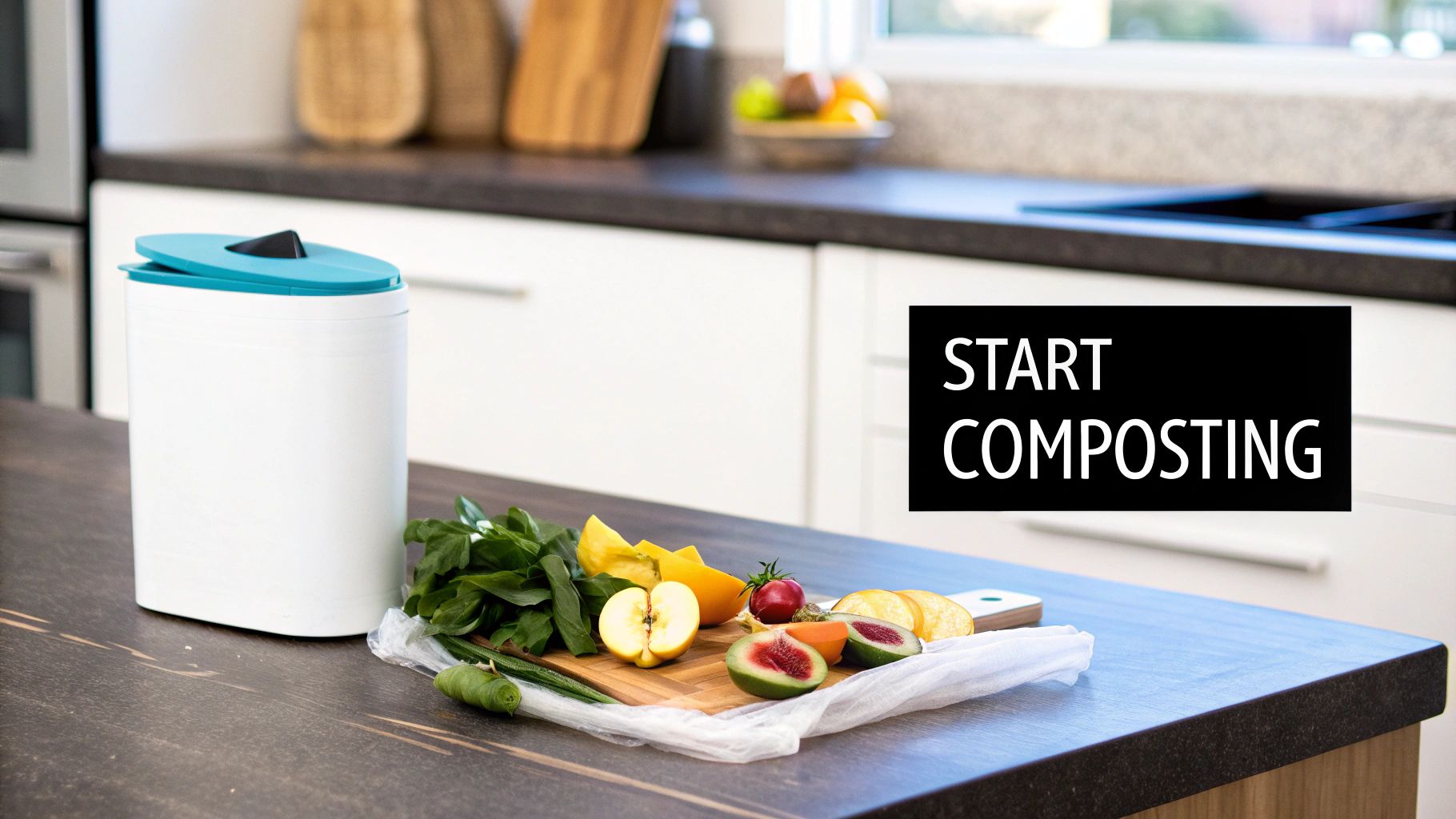
Jumping into composting can feel like a major commitment, but I'm here to tell you it’s far simpler than it seems. Your entire journey toward a more sustainable lifestyle can begin with a single, powerful choice. Just swap your ordinary plastic bin liner for a certified compostable one. That’s it. In one move, you've created a seamless, no-fuss system for separating your food waste.
This one small change is a gateway to a cleaner, more conscious kitchen. All those coffee grounds, eggshells, and veggie peels that once went to the trash? Now, instead of languishing in a landfill and releasing harmful gases, you’re giving them a new, vital purpose as nutrient-rich compost. This isn't just a small action; it's a powerful, practical way to shrink your household’s carbon footprint.
Why This Small Change Is a Massive Win
Every time you toss scraps into a compost kitchen bag, you're doing so much more than tidying up. You are actively participating in a positive, natural cycle. It's a deliberate choice that says you're committed not just to throwing less away, but to actively creating a healthier planet. And you're not alone. The demand for truly sustainable options is exploding.
Consider this incredible fact: the global market for compostable packaging, which includes these kitchen bags, is projected to skyrocket to USD 120.14 billion by 2032. This isn't some niche trend; it’s proof of a monumental shift in consumer consciousness.
This unstoppable growth means more innovation and better products are constantly hitting the shelves, making it easier than ever for you to get started. If you're new to this, a guide on how to start composting can build your confidence as you choose the right bags.
Making this simple switch empowers you to:
- Drastically Cut Landfill Waste: When food scraps rot in landfills, they release methane, a potent greenhouse gas. Composting stops this destructive process cold.
- Eliminate Kitchen Odors: A properly managed compost bin means your kitchen stays fresh and clean. Say goodbye to that foul garbage smell for good.
- Create Life-Giving Soil: Your food waste gets a second chance to do something incredible—become rich fertilizer that revitalizes gardens, farms, and local parks.
Ready to make an impact? Our guide on how to start composting for beginners demystifies the process with simple, actionable steps. Making the switch is a straightforward decision that delivers huge returns for your home and the environment.
The Brilliant Science Behind Compostable Bags
So, what truly separates a compostable bag from its plastic counterpart? It’s not magic—it’s brilliant science that mimics nature. The best way to think about a compostable kitchen bag is not as plastic, but as a strong, flexible leaf engineered for your kitchen.
At their core, these bags are made from materials called bioplastics, which are derived from renewable plant sources. One of the most common is Polylactic Acid, or PLA, typically made from fermented plant starches like corn or sugarcane. This plant-based foundation is the key that allows the bag to break down completely in the right environment.
Essentially, the microorganisms in a compost pile—the tiny bacteria and fungi that do all the hard work—see these bioplastics as food. They eagerly munch on the material, breaking it down into simple, natural elements: water, carbon dioxide, and the rich, organic matter we call compost. It’s the exact same cycle that decomposes an apple core, just harnessed to hold your kitchen scraps first.
The Two Worlds of Composting: Why It Matters
Now, here is the single most important concept to grasp: not all composting environments are the same. A bag’s ability to vanish back into nature depends entirely on whether it lands in a backyard compost pile or a specialized industrial facility.
- Industrial Composting: This is composting supercharged. These large-scale operations are precision-controlled environments. They maintain extremely high temperatures (often 131°F / 55°C or hotter), manage oxygen flow, and optimize moisture levels. This intense, heated environment is precisely what robust bioplastics like PLA need to decompose rapidly, usually within a few months.
- Home Composting: Your backyard bin is a much wilder, less predictable world. Temperatures fluctuate, and the material mix isn't perfectly balanced. Because of this, many standard "compostable" bags will fail to break down here; they demand the intense heat that only an industrial facility can provide.
This is exactly why checking for the right certification on a bag is not just important—it's everything. Tossing a bag designed for industrial composting into your home pile will only lead to frustration, as it could linger for months or years, becoming a persistent pollutant.
Understanding this distinction is the key to your success. Using the wrong bag for your composting method is like trying to bake a cake with the oven off—you have all the right ingredients, but the environment isn't right to create the final product.
Fueling a Growing Green Market
The science powering these bags isn't just an eco-fact; it's the engine of a booming green economy. As more of us embrace composting, the demand for products that deliver on their promises has skyrocketed, igniting a wave of innovation in sustainable materials.
The numbers are undeniable. In 2025, the global market for compostable bags is valued at USD 385 million and is projected to surge to an impressive USD 603 million by 2031. You can learn more about this market's growth and see how consumer demand is driving real change.
This incredible growth signals a powerful shift toward smarter, more responsible waste management. The best part? It’s making it easier than ever for you to find the perfect compost kitchen bags for your home.
How to Read the Labels: Your Guide to Choosing Wisely
Navigating the "green" products aisle can feel like a minefield of deceptive claims. Bags are often stamped with vague terms like "eco-friendly," "green," or "biodegradable," but these are frequently just marketing fluff. Without regulation, they mean almost nothing.
If you want a guarantee that your compost kitchen bags will actually decompose into healthy soil, you must look for official, third-party certifications. Think of them as a seal of trust from independent scientific experts who have rigorously tested these bags to prove they meet strict standards. Without a legitimate certification logo, you’re likely just buying green-colored plastic.
The Gold Standard Certifications You Can Trust
When you're shopping, train your eyes to spot these key logos. They are your assurance that a bag is genuinely compostable and will not harm the environment.
-
BPI (Biodegradable Products Institute): This is the undisputed leader in North America. The BPI logo is your proof that the bag is certified to break down safely in a commercial composting facility, leaving no toxic residue behind. Many municipal composting programs, like Portland's, will only accept BPI-certified liners.
-
TÜV AUSTRIA (OK compost HOME): This is the certification every backyard composter needs to know. The OK compost HOME seal guarantees a product will decompose properly even in the cooler, less predictable environment of a home compost pile. It is a much higher standard to achieve.
This diagram illustrates how the core materials in certified bags, like PLA and PHA, are born from plants.

It’s a simple but profound concept: the building blocks for these advanced bags come directly from renewable, natural sources.
To empower you to choose with confidence, here’s a breakdown of the most crucial certifications.
Key Compostable Bag Certifications at a Glance
| Certification Logo | What It Guarantees | Composting Environment | Primary Region |
|---|---|---|---|
| BPI Certified | The product will break down in a commercial composting facility within a specific timeframe without leaving toxic residue. | Industrial / Commercial | North America |
| TÜV AUSTRIA OK compost HOME | The product is proven to decompose at lower temperatures, making it suitable for a typical home compost pile. | Home / Backyard | Europe (Globally Recognized) |
| TÜV AUSTRIA OK compost INDUSTRIAL | Similar to BPI, this certifies that the product is suitable for industrial composting facilities. | Industrial / Commercial | Europe (Globally Recognized) |
| Seedling Logo | This certifies compostability in industrial facilities according to the European standard EN 13432. | Industrial / Commercial | Europe |
Knowing these logos empowers you to cut through the marketing noise and select a product that truly works.
The Danger of Uncertified Bags
Tossing an uncertified bag into your compost can sabotage your efforts. These imposters often fail to break down, contaminating entire batches of beautiful, finished compost with fragments of plastic.
Those tiny plastic bits, or microplastics, can get mixed into the soil, be absorbed by plants, and eventually find their way onto our plates. This is why certified compost kitchen bags aren't just a preference—they're essential for preserving the integrity of the composting cycle.
Learning to spot these logos is a small skill with a massive impact. For a deeper dive, explore our guide to compostable bin liners. A little knowledge will help you see past the misleading marketing and choose products that genuinely support your sustainable goals.
Choosing the Right Compost Bags for Your Kitchen
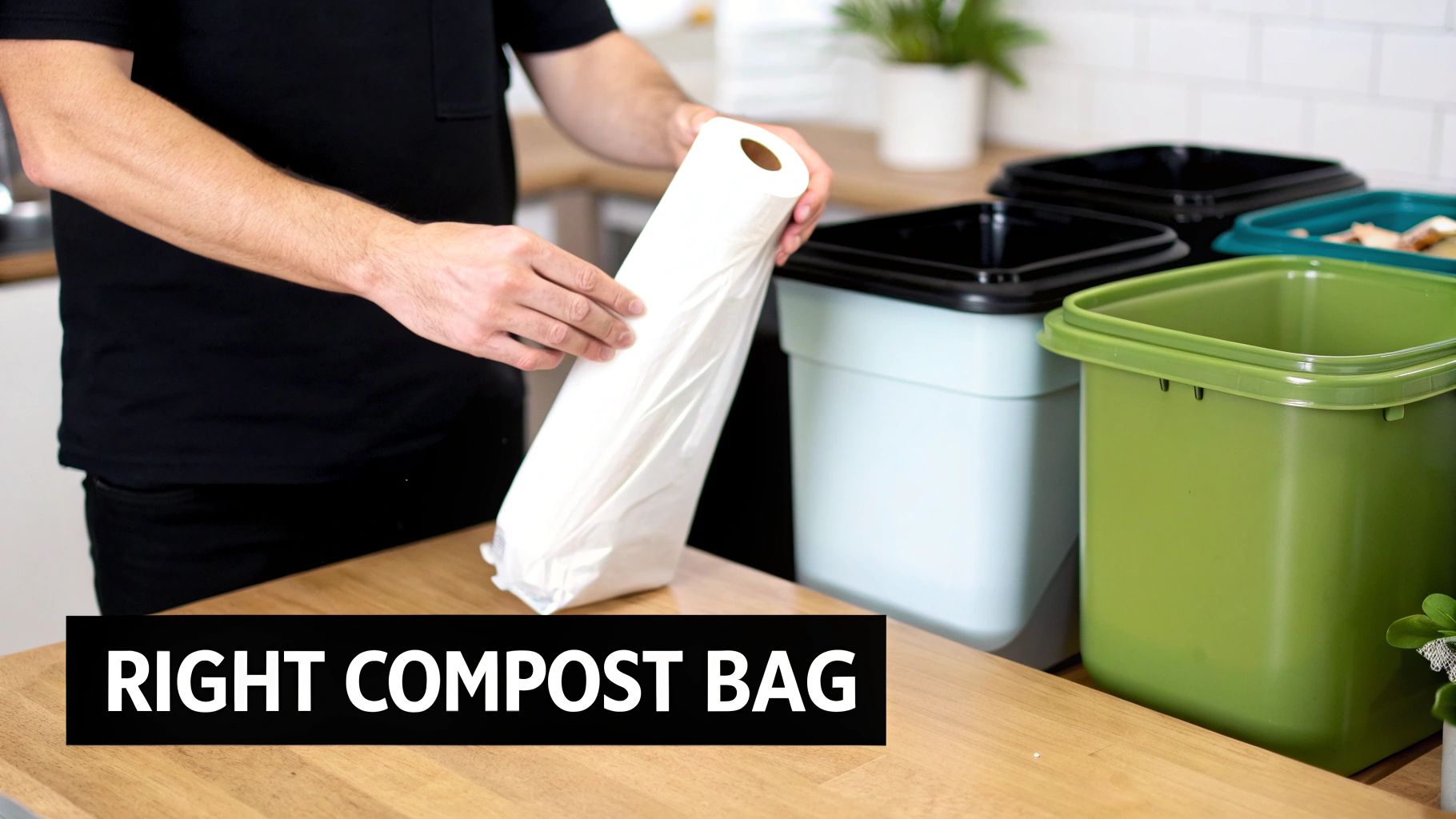
Staring at a shelf full of compost bags can feel overwhelming, but finding the right one is simpler than you think. It all comes down to a few practical details that can transform your composting routine from a chore into a seamless part of your day.
Think of it this way—you wouldn't use a shopping bag to line your trash can. The right tool makes any job easier, and the right compost bag makes the entire process cleaner, stronger, and far more effective.
Sizing and Strength: The Two Pillars of a Good Bag
First, you need a bag that fits your bin perfectly. A bag that’s too small will inevitably slip, creating a gooey mess. One that’s too large is just wasteful. Most countertop compost bins are designed for 2 to 3-gallon bags, which is the ideal size for collecting a few days of kitchen scraps.
Next, focus on thickness. This is your first line of defense against rips and leaks. Bag thickness is measured in mils, and it’s a number worth noting. While a flimsy, ultra-thin bag might seem like a bargain, a more robust bag—around 0.6 to 0.8 mils—gives you the confidence to toss in wet coffee grounds or heavy melon rinds without fearing a disastrous split on your way to the curb.
A strong, well-fitting bag is the difference between a clean kitchen and a frustrating mess. It’s a small detail that single-handedly eliminates the most common composting headache, giving you the peace of mind that your system just works.
Look for bonus features like reinforced seams, which provide an extra layer of security to keep moisture locked in. This matters. In 2018, the U.S. composted about 2.6 million tons of food. With studies showing that 67% of non-composters would start if it were easier, reliable products are the key to helping that number grow.
Finding the Sweet Spot Between Price and Quality
It’s tempting to grab the cheapest box, but this is often a false economy. A flimsy bag that tears the moment you lift it isn't a bargain; it’s a mess waiting to happen. The true value lies in finding the perfect balance between cost and dependable performance.
When comparing your options, look for these high-value features:
- Leak Protection: Bags with a star-sealed bottom are superior. This design distributes weight more evenly, preventing leaks from starting at the seams.
- BPI Certification: We’ve said it before, but it’s critical. The BPI logo is your guarantee that the bag meets strict standards for commercial composting, a non-negotiable for many city programs.
- Material Quality: Better materials don't just resist tearing; they excel at managing moisture and containing odors.
Knowing where to shop is also key. For more tips, check out our guide on where to buy compostable bags to find trusted brands. By focusing on these simple, practical elements, you can easily pick the right compost kitchen bags and set yourself up for total composting success.
Practical Tips for a Flawlessly Clean Composting Routine
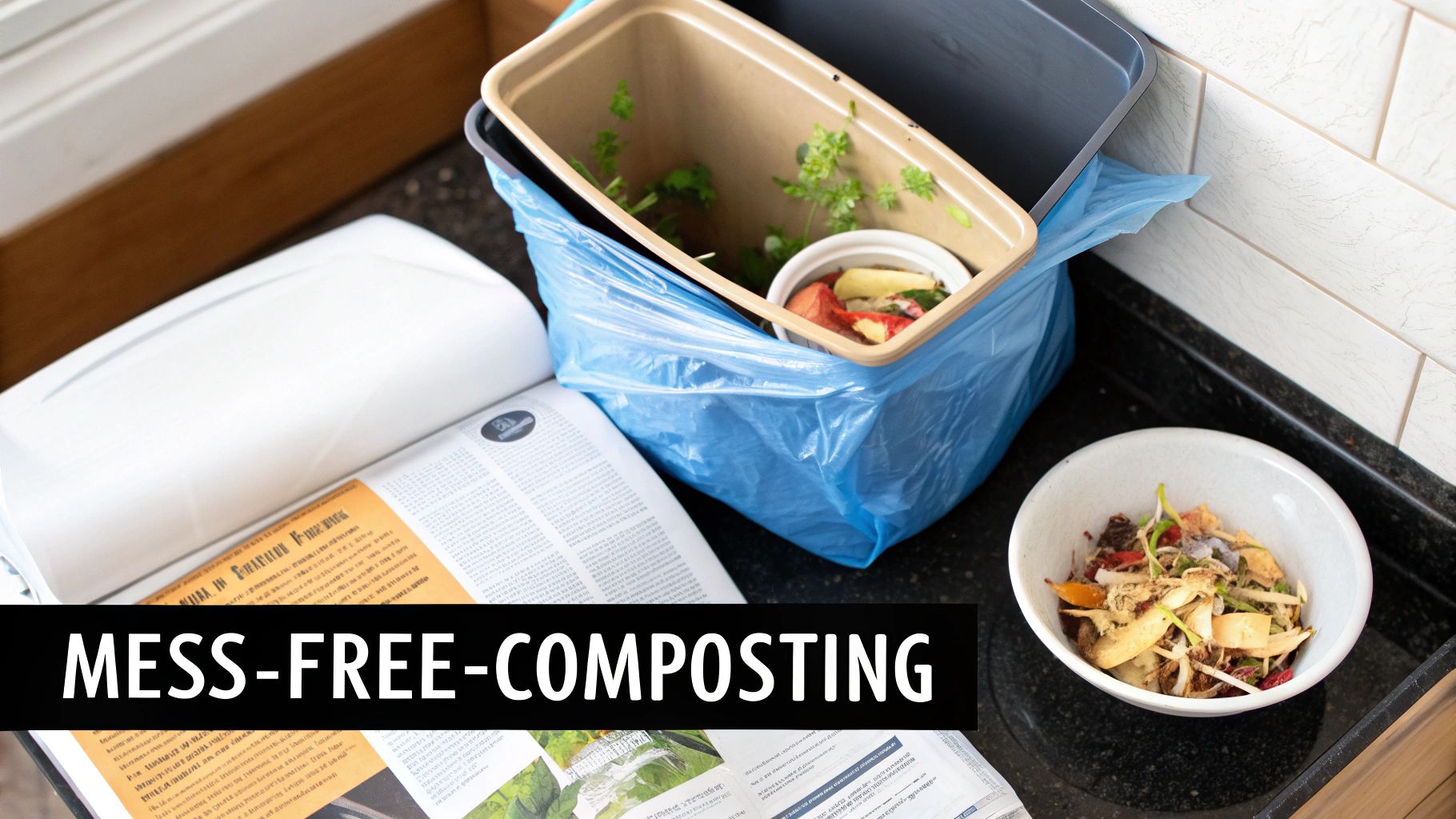
You’ve chosen the perfect compostable bags. Now, let’s make your daily routine just as smart. The goal is to build a system that prevents leaks, odors, and pests before they ever start. With just a few simple habits, you can keep your kitchen pristine and make composting feel completely effortless.
Your compostable bag is a high-performance tool, and it works best when used correctly. Just as a paper bag weakens when soaked, a compostable bag is literally designed to start breaking down when wet. Master the moisture, and you will master mess-free composting.
Mastering Moisture and Odor Control
Let’s be direct: the biggest complaints—soggy bags, surprise leaks, and funky smells—all stem from one single culprit: too much moisture sitting in the bag for too long. The good news? This is incredibly easy to solve. A dry bag is a strong bag.
One of the most effective tricks is to place a single paper towel or a folded piece of newspaper at the bottom of each new bag. It acts as a sponge, absorbing drips from coffee grounds and condensation from vegetable peels. This simple barrier helps the bag maintain its integrity for much longer.
Here’s the key thing to remember: These bags are designed to "breathe." This is a feature, not a flaw! It lets heat and moisture escape, which drastically reduces odors. But it also means the bag is always in the process of breaking down. Taking it out every 2-3 days is the golden rule, even if it isn't completely full.
This simple rhythm prevents food from putrefying and keeps your kitchen fresh. And speaking of kitchen hygiene, containing food waste properly is a crucial part of learning how to prevent roaches in your home, as exposed scraps are a major attractant for pests.
Smart Habits for a Stronger Bag
Beyond moisture management, a few other tweaks to your routine will make a world of difference. These small adjustments are all about preventing tears and ensuring your bag makes it from the kitchen to the curb without a single drip.
- Avoid Excess Liquid: Before tossing scraps, drain them. Let wet coffee grounds sit in the filter for an extra minute, or pour the liquid from leftover soup down the drain before composting the solids.
- Let Hot Foods Cool: Tossing in steaming leftovers creates a sauna inside the bag, which dramatically accelerates decomposition. Just let hot food cool on a plate for a few minutes first.
- Don't Overstuff: It’s tempting to push everything down to make more room, but this puts immense stress on the seams. It is always better to take the bag out a day early than to test its limits.
Why Your Bag Might Break Down "Too Fast"
Ever had a bag get flimsy ahead of schedule? It's not a faulty product; it’s a sign that the composting process has already started right inside your bin. This happens when you have the perfect storm of moisture, warmth from your kitchen, and plenty of "green" materials like fruit peels.
This isn't a flaw—it's the bag doing its job perfectly, just a little too early for your liking. Storing your bin in a cooler spot can help slow things down. Some people even keep their compost caddy in the freezer, which completely pauses decomposition until collection day. By following these practical steps, you can ensure your compost kitchen bags perform reliably every single time.
Your Questions Answered: Composting with Confidence
Starting a new habit like composting always brings up a few questions. That's perfectly normal. A little knowledge is all it takes to go from a composting novice to a confident pro.
Let's clear up the most common questions people have when they start using compostable kitchen bags.
Can I Throw These Bags in My Backyard Compost Pile?
This is the most critical question, and the answer is a firm "it depends." You can only use a bag in your home compost if it is explicitly certified for it. Look for the TÜV AUSTRIA 'OK compost HOME' logo on the box.
Most compostable bags, especially those with BPI certification, are engineered for the intense heat of industrial facilities, which operate at over 131°F—a temperature your backyard pile simply cannot sustain. If you toss an industrial-grade bag into your home bin, it will fail to decompose, becoming a frustrating piece of litter in your hard-earned compost.
Why Is My Compost Bag Getting Soggy and Leaking?
It feels like a failure, but a soggy bag is actually a sign it's working! These bags are made from plant-based materials designed to break down upon contact with moisture and organic waste.
The main culprits are wet food scraps—juicy melon rinds, coffee grounds, or leftover salad—which kickstart the decomposition process right in your kitchen.
Here’s how to prevent a mess:
- Lay down a liner. A paper towel at the bottom of the bag works wonders to absorb excess moisture.
- Drain wet items. Let juicy scraps sit in a colander for a minute before tossing them in.
- Take it out more often. Don't let it sit for a week. Emptying your bin every 2-3 days is the sweet spot for preventing leaks and odors.
Aren't "Biodegradable" and "Compostable" the Same Thing?
No, and this distinction is crucial. It’s easy to confuse these terms, but the environmental difference is massive. They are not interchangeable.
"Biodegradable" is a vague marketing term. It is unregulated and simply means something will eventually break down over an undefined period—which could be hundreds of years—and may leave behind toxic microplastics. A plastic bottle is technically biodegradable, but you wouldn't want it in your garden.
"Compostable", on the other hand, is a scientific standard. A certified compostable product has been proven to break down completely into non-toxic, natural elements within a specific timeframe, creating healthy soil. Always demand certified compostable, not just "biodegradable."
What Happens if a Compostable Bag Ends Up in a Landfill?
This is why proper disposal is everything. A compostable bag in a landfill is a wasted opportunity that actually causes harm. Landfills are packed so tightly that there is no oxygen, which is essential for composting.
Without oxygen, the bag and its contents break down anaerobically, releasing methane—a greenhouse gas over 25 times more potent than carbon dioxide at trapping heat in the atmosphere. To make a real difference, you must ensure your bags get to a proper composting facility.
Ready to start composting with confidence and without the mess? terravera offers BPI-certified compost kitchen bags built for strength and reliability. You can focus on doing good for the planet, and we'll handle the hassle. Check out our durable and dependable bags at https://www.myterravera.com and make the switch today.