

Your Complete Guide to Compostable Bin Liners: A Small Change with a Powerful Impact
Let's be clear: a compostable bin liner isn't just another plastic bag. It’s a complete reimagining of how we handle waste. Think of it as a temporary container for your food scraps, designed from the very start to break down into natural, non-toxic organic material—just like the apple cores and coffee grounds it holds.
It’s a simple but revolutionary idea: a container that returns to the earth along with its contents, leaving absolutely nothing harmful behind. This isn't just about managing trash; it's about creating a better, healthier cycle.
Why You Should Switch to Compostable Bin Liners Today
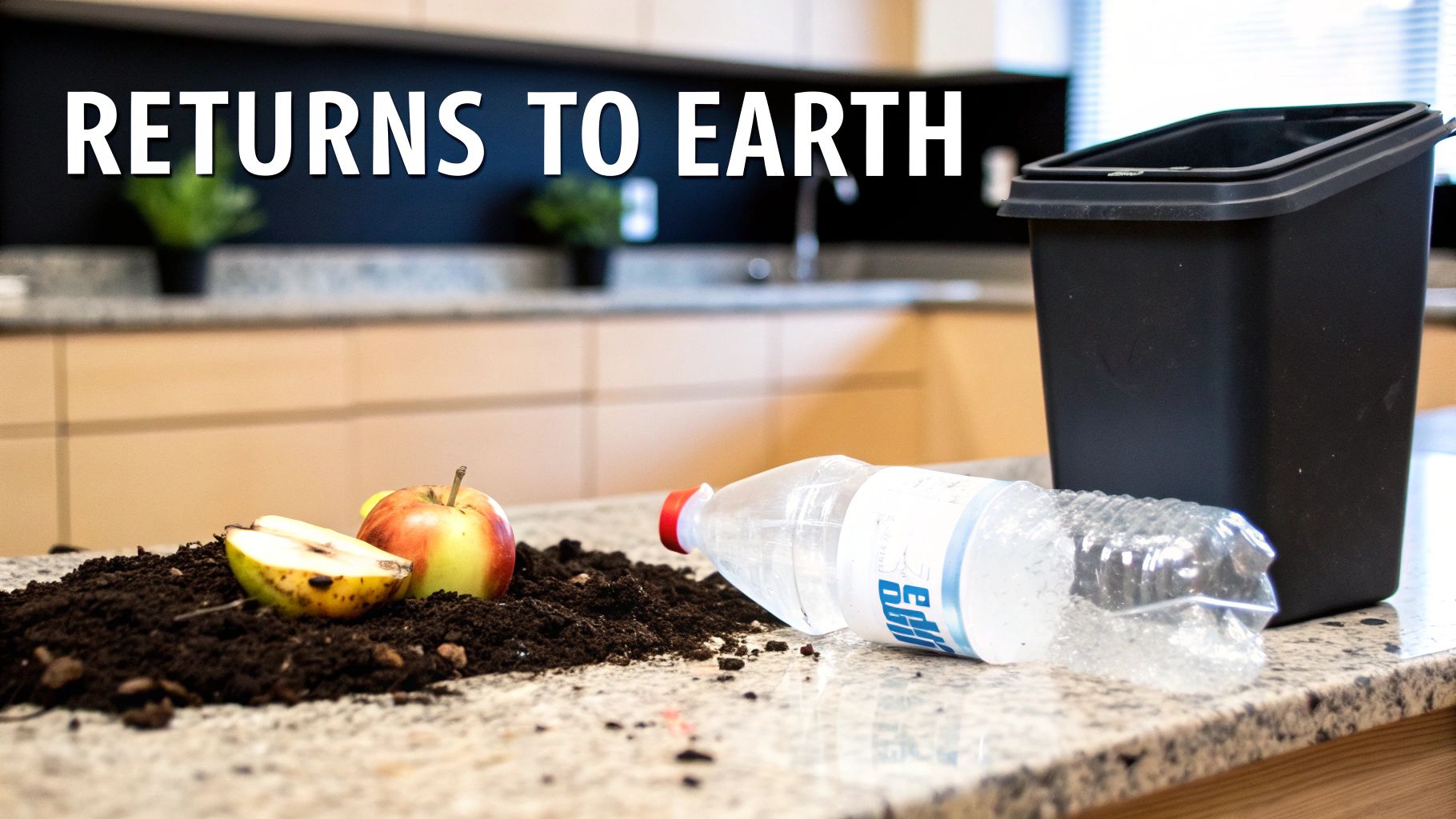
"Compostable" might sound technical, but the principle is beautifully simple. Picture an apple core you toss into a garden. Weeks later, it's gone—it has become part of the soil. Now, imagine a plastic bottle in that same spot. It’ll sit there for hundreds of years, a permanent scar on the landscape.
Compostable bin liners are engineered to be that apple core. They are a crucial part of a natural cycle, designed to break down completely into nutrient-rich humus when composted correctly. This closes the loop, transforming your food waste from a problem into a valuable resource, instead of letting it rot in a landfill.
This Is Your Chance to Make a Real Difference
Making the switch from traditional plastic to compostable liners is one of the easiest and most impactful decisions you can make for the planet. When food scraps get trapped in a landfill, they're starved of oxygen. This creates methane, a greenhouse gas far more potent and damaging than carbon dioxide. By choosing to compost, you directly fight climate change every single day.
This isn’t a niche eco-trend; it’s a global movement. The market for compostable bin liners is set to more than double, soaring from USD 366.5 million in 2025 to USD 756.3 million by 2035. This explosive growth is powered by people like you who are tired of waste and by governments finally cracking down on single-use plastics.
By choosing certified compostable products, you actively participate in reducing landfill burden and enriching our soil. It's a simple, practical action with far-reaching environmental benefits.
More Than Just a Bag
This push for sustainability goes way beyond home kitchens. Commercial spaces are also adopting these practices, and understanding the broader strategies for reducing food waste in commercial kitchens shows just how vital these products have become in large-scale waste management.
The bottom line is that using compostable bags helps us achieve several critical goals:
- Drastically Reduces Landfill Waste: Every bag of food scraps you compost is one less bag choking our overflowing landfills.
- Fights Climate Change: Proper composting prevents the anaerobic conditions that produce harmful methane emissions.
- Creates Black Gold for Soil: The final product is a supercharger for soil, eliminating the need for chemical fertilizers on farms and in gardens.
This makes compostable bin liners a smart, powerful choice for anyone who wants to stop feeling helpless about the environment and start making a tangible difference, right from their own kitchen.
The Smart Science Behind Plant-Based Bin Liners
Have you ever wondered how a humble corn plant can be transformed into a bin liner tough enough to handle your kitchen waste? It's not magic, but brilliant science that harnesses renewable resources to create something that works with nature, not against it. This is a universe away from traditional plastic bags, which are made from finite, polluting fossil fuels.
The journey for a compostable bin liner begins with plants rich in natural starches, like corn. This starch is harvested and then undergoes fermentation and polymerization to create a bioplastic known as Polylactic Acid (PLA). You can think of it as a natural recipe where plant sugars are baked into the building blocks for a revolutionary new material.
From Plants to Powerful Polymers
Of course, a bin liner must be both strong and flexible. That’s where a second compostable polymer, Polybutylene Adipate Terephthalate (PBAT), enters the picture. Its name is a mouthful, but its mission is simple: PBAT provides the stretch and puncture resistance we demand, ensuring the liner doesn’t split open on its way to the curb. Blending PLA and PBAT creates a material that’s both plant-based and primed for composting.
The real breakthrough is making something that performs like plastic when you need it to, but behaves like organic waste when you're done. It holds your rubbish securely, then disappears cleanly into the soil.
This shift toward plant-based materials is a powerful current, pushed forward by plastic bans and companies getting serious about sustainability. Major brands are turning to materials like PLA because they’re biocompatible, low-toxicity, and make sound economic sense. You can see more on the trends shaping the compostable packaging market over on Towardspackaging.com.
The Unmistakable Difference from Traditional Plastic
This plant-based origin story gets to the very heart of what separates a compostable bag from a regular plastic one. One is designed for a circular, renewable system that gives back to the earth. The other is part of a linear "take-make-waste" model that creates permanent pollution.
To learn more about the specifics of these materials, you can read our complete guide on what compostable bags are made of.
Once you understand the science, it's clear that compostable bin liners aren't just an alternative—they’re the obvious, intelligent solution. They prove we can create everyday items that are both effective for us and gentle on the earth, all starting with a simple plant.
Home vs. Industrial Composting: Read the Label, Change the World
Not all compostable bin liners are created equal, and the small certification logo on the package is your guide to making the right choice. Getting this right is the difference between helping the planet and accidentally causing more problems.
Think of it like baking. Some recipes are designed for your standard home oven, working perfectly with its gentle, steady heat. Others, like a complex sourdough, require the intense, controlled environment of a commercial bakery to succeed. Compostable bags follow the same principle.
The Industrial Composting Standard
Most compostable products you'll encounter are made for industrial composting. These facilities are the powerhouses of the waste world. They create the perfect conditions for decomposition with carefully managed high temperatures (55-60°C or 131-140°F), moisture, and oxygen. Your backyard pile simply cannot replicate this environment.
This intense process is essential to break down sturdy bioplastics like PLA in a timely manner. When you see a certification from the Biodegradable Products Institute (BPI), you can be confident it's been scientifically proven to fully decompose in one of these commercial sites. This is the gold standard for compostable liners in North America.
A BPI certification is your guarantee that a product won't contaminate the compost stream at a municipal facility. It's the mark of a truly responsible product.
The Home Composting Difference
On the other hand, home compostable liners are your "home oven" recipe. They are specifically engineered to break down at the lower, more variable temperatures of a backyard compost bin. They don’t need industrial-level heat to return to the soil.
The most trusted certification here is OK compost HOME. Seeing this logo means you can confidently toss the liner into your personal compost pile with your vegetable scraps and banana peels. It's vital to be clear on the language, though. "Biodegradable" and "compostable" are often used interchangeably, but they're not the same. To cut through the greenwashing, check out our definitive guide on compostable vs. biodegradable bags.
The journey to true compostability begins with the source material, as this decision tree illustrates.
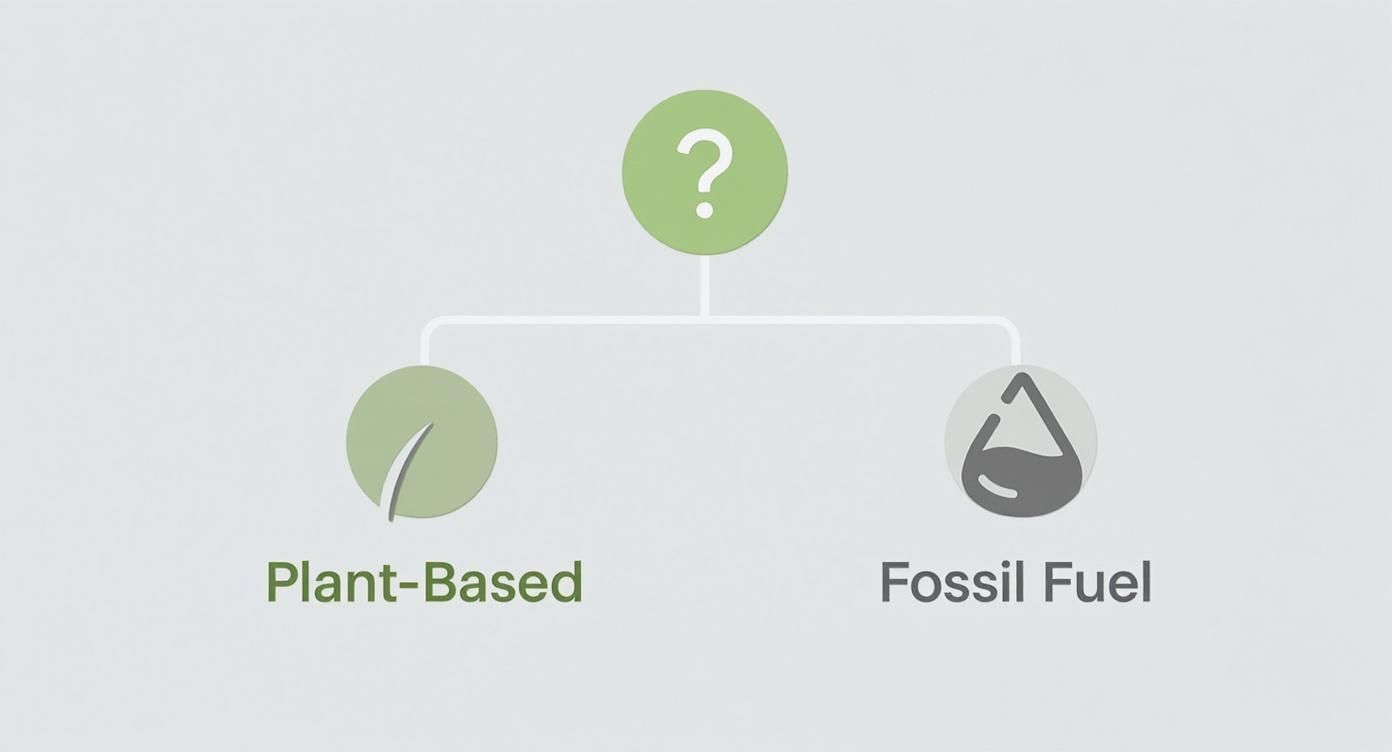
The first, non-negotiable step is choosing a product made from renewable, plant-based sources—this is what empowers it to integrate back into the earth's natural cycles.
Your Compostable Certification Cheat Sheet
Feeling lost in the logos? This quick guide breaks down the most common certifications so you can confidently choose the right bag for your bin.
| Certification Logo | What It Means | Where It Decomposes | Best For |
|---|---|---|---|
| BPI Certified | The liner has been scientifically tested to break down in a commercial composting facility within a specific timeframe (90-180 days). | Industrial/Commercial Composting Facilities | Anyone using a municipal green bin program or compost drop-off service. |
| OK compost INDUSTRIAL | Similar to BPI, this is a European standard (TÜV AUSTRIA) confirming the product is suitable for industrial composting conditions. | Industrial/Commercial Composting Facilities | Users of municipal green bin programs. Often found alongside BPI certification. |
| OK compost HOME | This certifies that a product will break down in the lower, variable temperatures of a backyard compost pile. It's a stricter standard to meet. | Home Compost Bins & Piles (and also industrial facilities) | Home composters who manage their own backyard piles or worm farms. |
Ultimately, choosing the right liner for your disposal method is the single most important action you can take. Putting an industrial-only bag in a home compost pile means it will linger for far too long, defeating the entire purpose. A home-compostable liner, however, works perfectly in both settings.
Always check the label before you buy. Your compost pile—and the planet—will thank you.
The Undeniable Environmental Impact of Your Choice
Let's be honest about the impact of these bags. To make the best choice, you need the full story. While compostable bin liners represent a massive leap forward for the environment, they aren't a magic wand for our waste crisis. Think of them as a powerful tool—one that becomes truly effective when you use it correctly.
The greatest victory? They divert enormous quantities of food scraps from landfills. When food waste is buried in a landfill, it's trapped without oxygen, causing it to decompose and release methane—a greenhouse gas over 25 times more potent than carbon dioxide at warming our planet. By making it clean and simple to compost your food scraps, these liners directly combat a major source of these destructive emissions.
It's About More Than Just Methane Reduction
The benefits don't stop there. The compost created from this organic waste is pure black gold for our soil. It's a nutrient-dense amendment that reduces our dependence on chemical fertilizers in farming and gardening. This helps regenerate depleted soil, improve its ability to hold water, and build a healthier, more resilient food system from the ground up.
Of course, a truly honest assessment means considering the whole picture. The crops used to make bioplastics, like corn, require land, water, and energy. This agricultural footprint is part of the environmental equation.
The crucial trade-off is this: we accept the resource cost of producing a plant-based liner to avoid the permanent pollution and potent methane emissions caused by sending organic waste to a landfill in a traditional plastic bag. The choice is clear.
Proper Disposal Is Non-Negotiable
This is where your role is absolutely critical. A compostable liner thrown into a regular trash bin headed for the landfill is arguably worse than a traditional plastic one. It can still produce methane as it breaks down, but you lose all the soil-building benefits of composting. Its environmental superpowers are only activated in the right environment: a commercial composting facility or a well-managed home compost pile.
This vital link between a smart product and conscious practice is gaining momentum. The global compostable plastic bag market was valued at around USD 1.5 billion in 2025 and is poised for major growth, driven by informed consumers like you who demand better options. If you're curious about the numbers, you can find more insights on this market trend on Archive Market research.
Ultimately, the true environmental impact of a compostable bin liner hinges on how it's used. It’s a partnership between intelligent product design and your commitment to the process. When you use them correctly, you’re not just throwing away trash—you’re actively participating in a circular solution that helps heal our planet.
How to Use Compostable Bags for Maximum Impact
Unlocking the full environmental benefit of your compostable bin liners comes down to one simple thing: using them correctly. Think of your liner as the first step in a powerful natural cycle. Your actions—from the moment it enters your kitchen to its final destination—determine whether it helps the planet or becomes part of the problem.
Let's walk through the simple, practical steps to ensure your compostable bags fulfill their promise, from managing moisture to finding their final resting place.
Step 1: Master Moisture Management
Because these liners are designed to break down, moisture is their kryptonite while they're still in your bin. Too much liquid can kickstart decomposition prematurely, leading to weak spots and leaks.
The solution is to keep things as dry as possible. Before tossing in wet food scraps like soupy leftovers or juicy melon rinds, give them a quick drain. A little dampness is fine, but a pool of liquid at the bottom is asking for trouble.
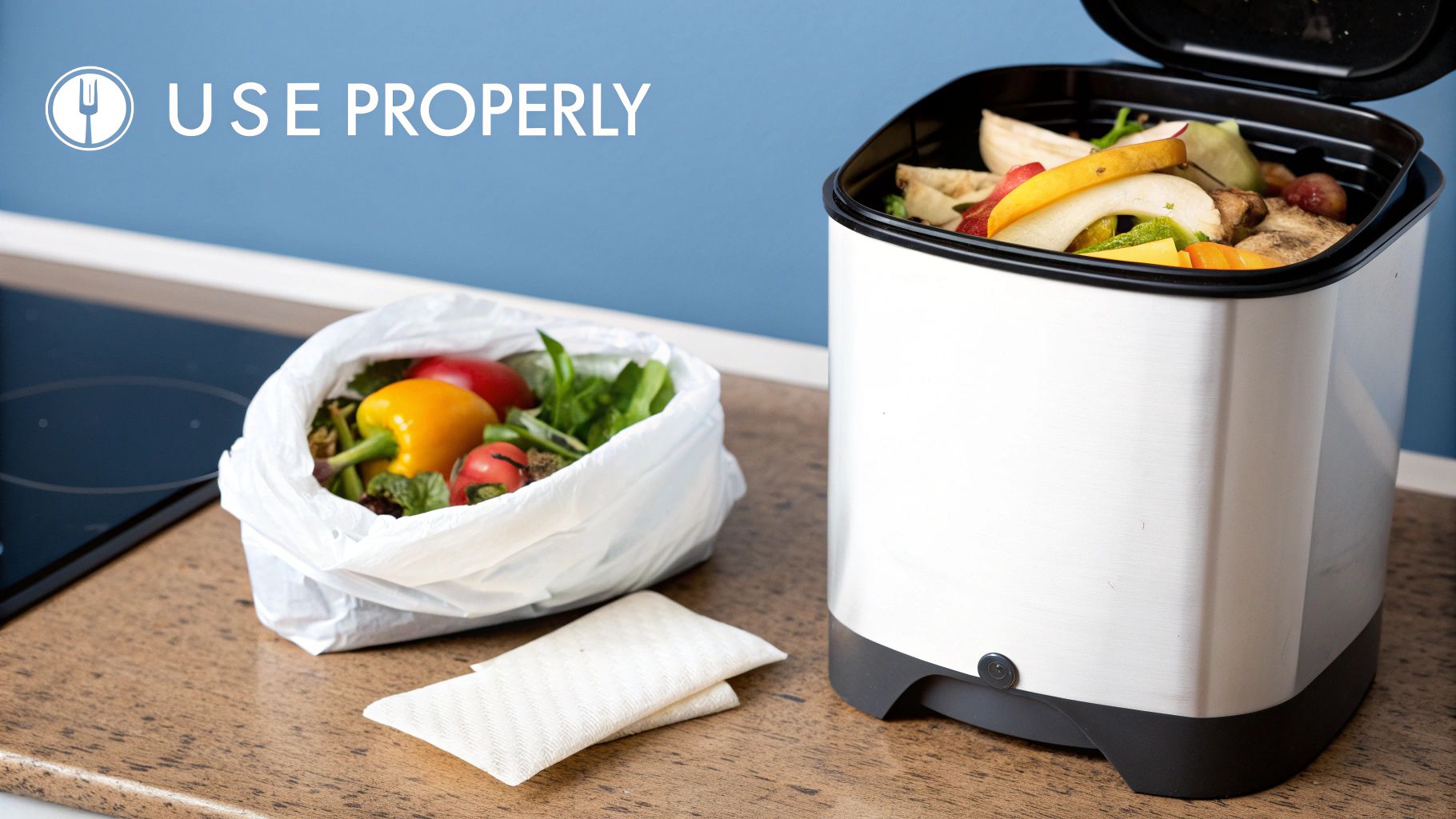
Here's a pro tip: place a paper towel or a folded piece of newspaper at the bottom of the liner. It will soak up excess condensation and add an extra layer of strength, keeping everything contained until disposal day.
Step 2: Fill It With the Right Stuff
Knowing what to put inside your compostable bin liners is just as important as knowing what to leave out. Your liner is a dedicated container for organic waste destined to become nutrient-rich soil.
What to Include:
- All Food Scraps: Fruit and veggie peels, eggshells, meat, bones, and dairy are all perfect. Coffee grounds are especially beneficial.
- Food-Soiled Paper: Paper towels and napkins used for cleanups can go right in.
- Yard Trimmings: Small amounts of leaves, plant trimmings, and grass clippings are great additions.
What to Exclude:
- Liquids: No cooking oils, grease, or milk. These must be disposed of separately.
- Pet Waste: This contains pathogens that must be kept out of finished compost.
- "Compostable" Packaging: Be vigilant. Unless an item is a BPI-certified compostable bag, so-called "compostable" cups and cutlery often fail to break down and should go in the trash.
Step 3: Choose the Right Final Destination
This is the most critical step of all. A compostable bag in a landfill is a wasted opportunity. Without oxygen, it can't decompose as designed and may release methane—the very greenhouse gas we are fighting to avoid.
The final destination determines the success of your composting efforts. Your liner needs the specific conditions of a composting environment to complete its life cycle and return to the earth.
You have two powerful options:
-
Industrial Composting Facility: This is the ideal destination for most certified compostable liners. These facilities provide the high temperatures needed to break down bioplastics quickly and safely. Check with your local municipality for curbside green bin programs or community drop-off sites.
-
Home Composting Pile: If your bags are certified as "OK compost HOME," you can add them directly to your backyard pile. For anyone new to this, we've created a guide on how to compost at home that walks you through setting up your own system from scratch.
Understanding what makes a healthy home compost pile is key. For example, adding coffee grounds correctly can supercharge your compost, as this a comprehensive guide to composting coffee grounds at home explains. By following these simple steps, you guarantee your compostable bin liner lives up to its promise, turning kitchen scraps into a valuable resource for the planet.
How to Choose the Best Compostable Bin Liner for Your Home
You’re ready to make the switch. Choosing the right compostable liners for your home doesn't have to be complicated. In fact, it's incredibly simple when you know what to look for.
A smart purchase comes down to three crucial factors: size, strength, and above all, certification. Get these three right, and you'll have a liner that works perfectly and delivers on its environmental promise.
Finding the Perfect Strength and Size
First, let's nail the fit. There's nothing more frustrating than a bag that's too small and slips into the bin, or one that’s so large it feels wasteful. Check the volume of your kitchen caddy—it's usually printed on the bottom in gallons or liters—and match it to the liner size. A snug fit is a secure fit.
Next is the bag's thickness, measured in "mil". A higher mil number means a thicker, more durable bag.
- For light kitchen scraps: A liner around 0.6-0.8 mil is perfect for everyday food waste like coffee grounds, fruit peels, and leftovers. It's more than strong enough for daily use.
- For heavier loads or yard waste: If you're dealing with soggy food, meaty bones, or yard trimmings, choose something 1.0 mil or thicker. That extra durability provides peace of mind against rips and leaks.
But here is the most important rule: you must verify the certification. This is the only way to know you’re buying a genuinely compostable product and not just falling for deceptive marketing.
How to Spot Credible Brands and Avoid Greenwashing
Trustworthy brands are proud of their credentials and display them clearly on the package. Be skeptical of vague, meaningless terms like "eco-friendly," "earth-friendly," or "biodegradable." Without a legitimate certification, these words are often just greenwashing.
What you must look for are the official logos from respected third-party organizations. The most important ones are the Biodegradable Products Institute (BPI) for industrial composting and TÜV AUSTRIA's OK compost HOME for home compost piles.
Seeing one of these logos is your proof that the product has undergone rigorous scientific testing and is guaranteed to break down as promised. When you choose a certified product, like our liners at Terravera, you can feel confident that you're making a real, positive impact.
Your Questions, Answered.
Embracing a more sustainable lifestyle always brings up a few questions. That's a great sign—it means you're thinking critically about your choices. Let's clear up the most common questions about compostable bin liners so you can move forward with total confidence.
A frequent question is whether these bags can be recycled. The answer is an emphatic no. Compostable liners are designed to decompose with organic waste. Tossing them in the recycling bin can contaminate an entire batch of materials, dooming it all to the landfill.
Will These Bags Actually Hold Up?
It's a valid concern. You need a bag that won't fail you on the way to the curb. High-quality compostable liners are surprisingly tough, but since they are designed to decompose, they have a shorter lifespan once in use. Their main weaknesses are moisture and sharp objects.
Here’s how to prevent any messy situations:
- Change the bag every 3-4 days, even if it isn’t full.
- Let very wet items, like coffee grounds or fruit rinds, drain for a moment before you toss them in.
- Be mindful of sharp objects like eggshells, bones, or wooden skewers.
Following these simple tips will ensure your bag performs flawlessly until collection day.
Biodegradable vs. Compostable: The Critical Difference
This is perhaps the most important distinction to grasp, as it empowers you to see through misleading "green" marketing. "Biodegradable" sounds positive, but it's a dangerously vague term. It simply means something will eventually break down, but that process could take centuries and leave behind toxic microplastics.
Compostable, on the other hand, is a specific, certified, and legally defined standard. It is a guarantee that a product will break down completely into healthy, non-toxic soil within a defined timeframe (90-180 days) in a proper composting environment.
When you shop, always demand the official "compostable" certification. It’s the only way to be certain you're buying a product that will truly return to the earth without a trace.
Ready to start composting with confidence? The team at Terravera has designed certified compostable liners that are strong, reliable, and perfect for your kitchen. Explore our Terravera products and begin your journey to a healthier planet today.