

How Long Do Plastic Bags Take to Break Down? The Shocking Truth
Ever wondered how long that plastic bag you just used will be around? The answer is staggering and should concern every single one of us: anywhere from 10 to 1,000 years. That isn't a typo. A single bag, used for maybe ten minutes, can outlive you, your children, and your grandchildren, poisoning the planet for generations.
The massive range in that number comes down to one thing: where the bag ends its journey. Sunlight, air, and soil are the difference between a few decades and an entire millennium of pollution.
The True, Indestructible Lifespan of a Plastic Bag
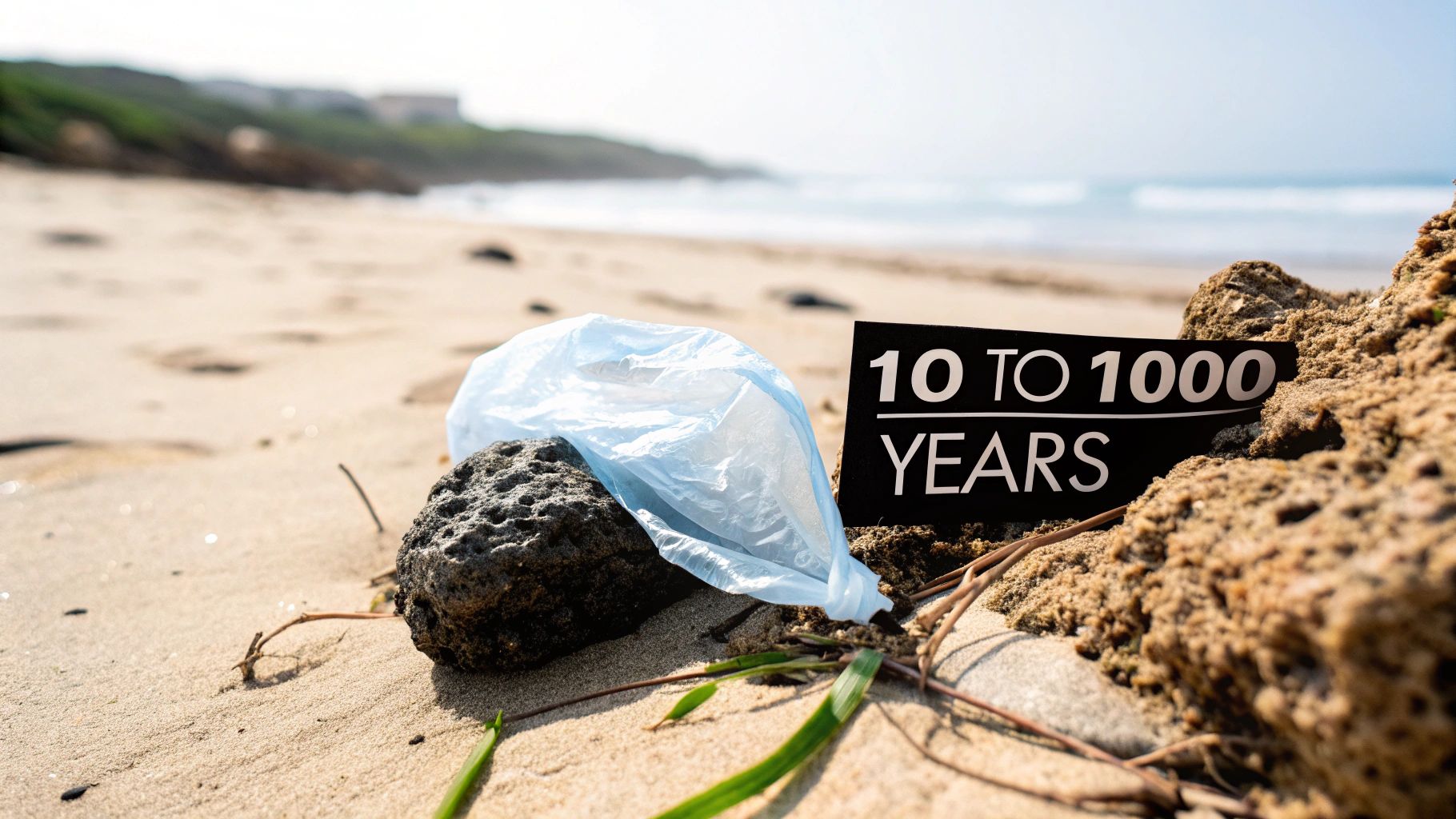
It’s tempting to think of a plastic bag "breaking down" like an apple core that biodegrades back into the earth. This is a dangerous misconception. A plastic bag never truly goes away.
A better analogy is a rock on the beach. Over time, waves and sun break that rock into smaller pebbles, and eventually into grains of sand. The rock is gone, but the sand—its fundamental material—is still there. Plastic bags do the exact same thing. They don't vanish; they shatter into a storm of microscopic plastic pieces that contaminate our soil and water for centuries.
The Terrifying Scale of the Plastic Bag Problem
This process of fragmentation unleashes a flood of toxic particles called microplastics, a pervasive environmental plague we'll dig into later. The sheer volume of bags we use transforms this from a small issue into a global crisis.
To put it in perspective, the United States produced around 730,000 tons of plastic bags, sacks, and wraps in a single year. The worst part? Over 87% of those items were never recycled. Buried in a landfill, deprived of the sun and oxygen needed to even begin fragmentation, a bag might take not just decades, but centuries to break apart.
You must understand this: "breaking down" does not mean disappearing. For plastic, it means transforming from a visible eyesore into an invisible, pervasive poison that saturates our ecosystems.
How Different Bags Compare
Not all bags are created equal. The material they're made from and the environment they're discarded in drastically alter their lifespan.
To give you a snapshot of this environmental battlefield, we've created a table comparing the timelines for different bags. This will expose why some "eco-friendly" options are nothing more than greenwashed lies. You can also explore the broader environmental impact of plastic bags in our related guide.
Estimated Decomposition Times for Common Bag Types
| Bag Type | Optimal Conditions (Sunlight, Air) | Landfill or Ocean (Low Oxygen/Sunlight) |
|---|---|---|
| Conventional Plastic Bag | 10-20 Years | 500-1,000+ Years |
| Oxo-Degradable Bag | 1-3 Years | 5-10+ Years (fragments faster) |
| Biodegradable Plastic Bag | 6 Months - 5 Years | 100+ Years (conditions are wrong) |
| Certified Compostable Bag | 3-6 Months (in compost facility) | Will not break down properly |
As you can see, the environment plays a decisive role. A bag that fragments relatively quickly in the open can linger for a millennium when buried in a landfill or lost in the ocean. This proves that proper disposal is just as important as the type of bag you choose.
Why Plastic Bags Just Don't Go Away
To understand why plastic bags are essentially immortal, we must look at what they are. At its core, a plastic bag is a marvel of chemical engineering—designed to be strong, flexible, and impossibly tough. That resilience is great for carrying groceries, but it’s an absolute nightmare for the planet.
Most bags are made from polyethylene, a polymer derived from petroleum. It's a super long, super strong chain of identical molecules linked tightly together. This structure is entirely artificial; nature has no idea what to do with it.
Because of this, the microorganisms in our soil and water—nature’s dedicated clean-up crew—are utterly defeated. They lack the enzymes needed to break down polyethylene's synthetic bonds. So, while an apple core is devoured and recycled back into the earth, a plastic bag is treated as an indestructible alien object.
The "Disappearing" Act: The Lie We Tell Ourselves
This brings us to a crucial point: the difference between something truly biodegrading and the illusion of a plastic bag breaking down.
-
Biodegradation is nature’s perfect recycling system. It’s an organic process where living things like bacteria and fungi consume a material, breaking it down into simple, life-giving elements like water, carbon dioxide, and new soil. Nothing is wasted.
-
Photodegradation is what happens to plastic. This isn't a biological process; it's a violent physical shattering. The plastic isn’t being recycled. It’s being pulverized by an outside force: the sun's ultraviolet (UV) light.
Think of it like a glass bottle dropped on a sidewalk. The bottle is gone, but now you have hundreds of tiny, sharp shards of glass that will stay glass forever. That is exactly what photodegradation does to a plastic bag. It doesn't eliminate the plastic; it just shatters it into smaller, more dangerous pieces.
Sunlight Turns One Big Problem into a Million Tiny Ones
The sun’s UV rays assault the chemical bonds holding the polyethylene chain together, making the plastic brittle and causing it to crack. Over time, it fragments into an endless cascade of tinier particles, now known as microplastics.
This process is why a plastic bag might take around 20 years to fragment under ideal sunny conditions, but centuries when it’s buried in a dark landfill. In the ocean, a plastic shopping bag can take up to 20 years to fragment into a toxic cloud of micro-particles. For a deeper dive, Chariot Energy explains how plastic decomposes.
This also explains why that tattered bag you see stuck on a fence seems to "disappear." It hasn't vanished. It has morphed from one piece of trash into an invisible contaminant scattered everywhere.
The most convincing illusion a plastic bag performs is its own disappearance. When it seems to vanish, it has actually just transformed into a more dangerous and widespread threat in the form of microplastics.
These microscopic bits of plastic are now light enough to be carried by the wind and washed away by rain. They infiltrate our soil, our oceans, and ultimately, our food chain. The bag is out of sight, but its plastic essence is now a hidden, serious threat to ecosystems worldwide. This is the simple, scientific reason they refuse to truly go away.
Decoding the Labels on Eco-Friendly Bags
Walking down the supermarket aisle, you're bombarded with choices. Many have green leaves and earthy packaging, with labels like "biodegradable" or "oxo-degradable" that promise an easy win for the planet. Are they really?
The truth is, the world of eco-friendly bags is a minefield of confusing terms and deceptive marketing. Some of these bags are just conventional plastic in a clever disguise, designed to make you feel good while doing just as much harm. To make a real difference, you must become a label detective and understand what these claims actually mean.
A Guide to Understanding Eco-Friendly Bag Claims
Don't get lost in the jargon. Let's expose what the most common terms you'll see on packaging really mean for our planet.
| Bag Type | Breakdown Process | End Result | Key Takeaway |
|---|---|---|---|
| Oxo-Degradable | Fragments with oxygen and UV light. | Tiny pieces of plastic (microplastics). | This is not biodegradation; it just accelerates plastic pollution. |
| Biodegradable | Can be broken down by microbes under specific, often industrial, conditions. | Varies; often behaves like regular plastic in a landfill. | The term is dangerously vague and often meaningless. |
| Certified Compostable | Decomposes into natural elements in a controlled composting environment. | Non-toxic, nutrient-rich compost (humus). | The only true circular solution when disposed of correctly. |
As you can see, not all "green" bags are created equal. The wrong choice can, and often does, do more harm than good.
Oxo-Degradable: The Hidden Plastic Problem
First up are oxo-degradable bags. They are sold as a solution because they appear to disappear much faster than a standard plastic bag. But this disappearance is a terrifying illusion.
These bags are made from regular plastic, like polyethylene, with chemical additives mixed in. These additives cause the plastic to shatter into tiny pieces when exposed to oxygen and sunlight. So, instead of decades, an oxo-degradable bag can fragment in just a few years.
The problem? You're left with the exact same material—plastic. It doesn't biodegrade; it just creates microplastics on an accelerated timeline. Many experts now consider them more harmful than conventional bags because they fast-track the spread of plastic pollution into our soil and water.
An oxo-degradable bag is like painting a regular plastic bag to look like a leaf. It might look different, but underneath, it's still the same plastic, destined to become microplastic pollution, just at a faster rate.
Biodegradable: Not What It Sounds Like
The term biodegradable feels comforting. It conjures images of an apple core returning to the earth. In reality, the term is so broad and unregulated that it has become almost meaningless.
For something to be truly biodegradable, microorganisms must break it down into natural elements. While some plastics are designed for this, they require the very specific conditions of an industrial composting facility—high heat, oxygen, and a rich microbial environment.
When a "biodegradable" plastic bag is thrown in the trash and ends up in a typical landfill, sealed away from oxygen and the right microbes, it cannot do its job. It will likely sit there for a century or more, behaving just like a conventional plastic bag. This is a critical distinction you can learn more about by exploring the difference between compostable and biodegradable bags.
Certified Compostable: The Gold Standard
This brings us to certified compostable bags. This is the only label with a clear, regulated, and scientifically-backed meaning. These bags aren’t made from petroleum. Instead, they’re created from plant-based materials like cornstarch (PLA) or other biopolymers.
To earn this certification, a bag must meet strict standards proving it will completely break down into non-toxic, natural components within a specific timeframe in a composting facility.
Here’s what truly sets them apart:
- Complete Decomposition: They don't just fragment. Microorganisms fully consume them, turning them back into soil-enriching compost, also known as humus.
- No Toxic Residue: The process leaves behind only water, carbon dioxide, and organic matter. No harmful plastic bits are left behind.
- Strict Timelines: They must break down within about 90-180 days in an industrial facility—a tiny fraction of the time a plastic bag takes.
The key is that these bags are designed for a specific system. They belong in a municipal or industrial compost bin, not a landfill and never a recycling bin, where they contaminate the plastic recycling stream. When used correctly, they are the only single-use bag option that is truly part of a circular, waste-free system.
How the Environment Controls a Bag's Fate
Where a plastic bag ends up is just as important as what it's made of. A bag's final resting place—be it a sun-baked beach, a dark and airless landfill, or the cold ocean depths—is the single biggest factor in how long it will stick around. Think of the environment as a control panel, turning the dials way up or down on the decomposition clock.
Let's imagine two identical plastic bags. One gets caught by the wind and lands on a sidewalk, exposed to sunlight and air. The other is tossed in the trash and buried deep inside a massive landfill. Their journeys from this point on couldn't be more different.
This tale of two bags is exactly why there's no single, simple answer to how long a plastic bag takes to disappear.
The Power of Sunlight and Oxygen
The bag on the sidewalk has it rough, which is a good thing. It’s bombarded daily by the sun's powerful ultraviolet (UV) rays, which attack and weaken its chemical bonds. Oxygen in the air joins the assault, helping make the plastic brittle and fragile.
This one-two punch of sunlight and air is known as photodegradation. Over months and years, the bag will crack, flake, and shatter into countless smaller pieces. While this might only take 10 to 20 years, the bag doesn't truly vanish. It just becomes microplastic dust, scattered by the wind.
Now, let's check in on our second bag. Its story is completely different.
The Landfill Tomb
Buried under mountains of trash, the bag in the landfill is cut off from everything that could break it down. It’s essentially sealed in a dark, oxygen-starved tomb.
Without sunlight, photodegradation comes to a screeching halt. Without oxygen, the few microbes that could potentially nibble on the plastic can't survive, let alone work effectively. In this strangely stable, protected environment, the plastic bag is practically preserved. It won’t last for decades—it will last for centuries, potentially for 500 years or more.
This is why a landfill is one of the worst places for any type of bag, even those labeled "biodegradable." The conditions are just all wrong for any real decomposition to happen. It also shows how confusing those labels can be if you don't know the science behind them.
The infographic below really helps clarify the differences between common "eco-friendly" bags and what their labels actually mean.
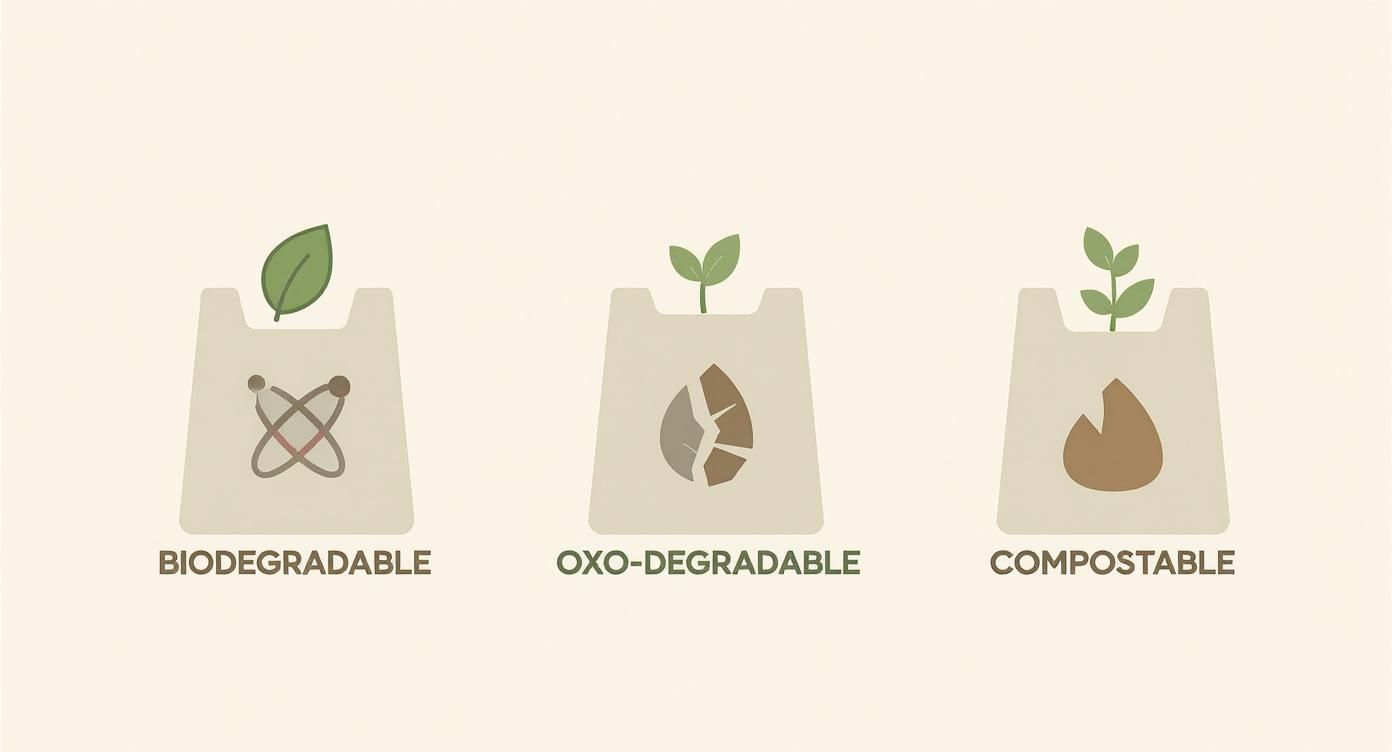
As you can see, only certified compostable bags are truly designed to break down biologically. The others often just fragment into microplastics or do nothing at all in a landfill.
The Role of Temperature and Location
Beyond just sunlight and air, other environmental factors play a huge role. Temperature, moisture, and the local microbial life all have a say in how fast things break down.
- Hot, Humid Climates: Warmer temperatures can speed up the chemical reactions that make plastic brittle, which accelerates fragmentation.
- Cold, Dry Climates: In colder, drier regions, the whole process slows way down, preserving plastic for much longer.
- The Deep Ocean: In the frigid, dark depths of the ocean, a plastic bag is shielded from UV light and there’s very little oxygen. Here, it can persist for centuries, becoming a long-term hazard for marine animals.
The environment is the ultimate decider of a plastic bag's lifespan. A 20-year timeline in one scenario easily becomes a 500-year sentence in another, proving that where we throw things away matters just as much as what we throw away.
The Invisible Threat of Microplastics
When a plastic bag finally shatters after decades, its story doesn't end. Its most dangerous chapter is just beginning. The bag doesn't disappear—it transforms into a pervasive, invisible threat known as microplastics.
These are the tiny, microscopic fragments left behind by every conventional plastic bag. Think smaller than a grain of rice. They're the shattered remnants of a product designed for convenience but built to last forever, and they have become one of the most widespread pollutants on the planet.
These tiny particles are now found everywhere, from the pristine snow on Mount Everest to the crushing depths of the Mariana Trench. They are silently infiltrating every corner of our ecosystem.
How Microplastics Become Toxic Sponges
Think of microplastics as tiny, floating sponges with a nasty habit. As they drift through the ocean or get mixed into the soil, their chemical structure is perfect for attracting and absorbing harmful pollutants from the surrounding environment.
They soak up dangerous substances that have already leached into our ecosystems, creating a highly concentrated poison pill. This toxic cocktail can include:
- Pesticides from agricultural runoff.
- Heavy metals from industrial waste.
- Persistent organic pollutants (POPs) like PCBs, which were banned decades ago but still haunt our environment.
This process turns a seemingly harmless speck of plastic into a delivery vehicle for toxic chemicals, ready to be ferried directly into the food chain. The plastic itself is a problem, but what it carries makes it so much worse.
The Alarming Journey Up the Food Chain
Once these contaminated particles are out there, they begin a sinister journey. The process starts at the very bottom of the food web and works its way up, concentrating the toxins at each step.
It all begins with the smallest organisms. Tiny zooplankton, the foundation of all aquatic life, mistake these plastic fragments for food and swallow them. This is the first link in a chain of contamination that leads directly to our dinner plates.
From there, the path is predictable and deeply concerning. Small fish eat the contaminated plankton, accumulating both the plastic and its toxic hitchhikers in their bodies. Larger fish then prey on these smaller fish, and the concentration of pollutants magnifies with each meal.
This process is called biomagnification. It means that predators at the top of the food chain—including seals, seabirds, and even us—can end up with dangerous levels of toxins in their systems.
The real danger of microplastics isn't just the plastic itself, but its ability to act as a Trojan horse, carrying a payload of concentrated environmental poisons into the bodies of living organisms, including our own.
A Legacy of Pollution We Cannot Ignore
The scale of this problem is staggering. A landmark 2017 study revealed that of the 6,300 million metric tons of plastic waste ever generated by 2015, a shocking 79% had piled up in landfills or the natural environment. You can dig into the global production and fate of plastics to see the full, sobering picture.
This isn't just about bags floating in the ocean. It's about creating a permanent, microscopic contaminant we can no longer see or easily clean up. And while plastic bags are a major culprit, other everyday items are contributing to the problem, too. It’s worth learning about the unseen risks of microplastics from plastic cutting boards to understand how widespread the issue truly is.
That plastic bag you used for ten minutes will eventually break down, but it never truly goes away. It just changes form, becoming a permanent part of our soil, our water, and the wildlife that depends on them. This invisible threat is a powerful reason why understanding the true lifecycle of a plastic bag is more urgent than ever.
Actionable Steps to Reduce Plastic Waste
https://www.youtube.com/embed/W1wmSJsxk3w
Thinking about a 1,000-year legacy of plastic pollution can be overwhelming, but it must be our motivation for change. The good news is, you have the power to make a real difference. Small, consistent choices add up, and when communities adopt them, the ripple effect is huge.
It's time to move beyond just "reduce, reuse, recycle." It's time to build sustainable habits that attack the plastic problem at its root. This is about making conscious choices that create a healthier planet.
Master Proper Disposal
One of the biggest impacts you can have starts with putting your waste in the right place. It sounds simple, but getting it right is crucial—one wrong item can throw the whole system off track.
-
Your Recycling Bin: Never, ever toss plastic grocery bags or any plastic film in your curbside recycling. They are the number one enemy of recycling machinery, getting tangled up and causing expensive shutdowns. This rule also applies to "biodegradable" and "compostable" bags, as they contaminate the plastic recycling stream.
-
Your Compost Bin: This bin is for certified compostable bags only. Tossing a conventional plastic bag or even a "biodegradable" one in here introduces petroleum-based plastics into the compost, ruining all that good organic material.
-
Store Drop-Off Bins: This is the right way to recycle plastic bags. Many grocery stores and big-box retailers have collection bins right at the entrance for your plastic bags, bread bags, and other stretchy plastic films. These materials are then sent to special facilities equipped to handle them properly.
Embrace the Power of Reusability
Honestly, the most effective way to fight plastic bag waste is to stop using them completely. Swapping them out for a few sturdy, reusable bags is a simple change with an enormous payoff.
Think about it: one good reusable bag can take the place of hundreds—maybe even thousands—of single-use plastic bags over its lifetime. The key is to make it a habit. Keep them in your car, tuck one in your backpack, or hang them by the door so you always have them on hand. If you're looking to take things a step further, exploring various eco products can help you find sustainable replacements for many other common plastic items.
Shifting from single-use convenience to long-term durability is the heart of a low-waste lifestyle. Every time you choose a reusable bag, you prevent another piece of plastic from potentially polluting the environment for the next 1,000 years.
Make Smart Choices When You Need a Single-Use Option
Let's be realistic—sometimes a single-use bag is just necessary. When you find yourself in that situation, making the right choice is what matters.
Certified compostable bags are the only single-use option truly designed to break down and return to the earth without leaving harmful microplastics behind. They’re a perfect solution for lining a kitchen compost pail or for those times when a reusable bag just won't work. To see how these solutions fit into a broader strategy, check out our guide on how to reduce plastic waste. Making these smart, informed choices is how you become part of the solution.
Got Questions? We've Got Answers
Even after digging into the science, a few common questions always seem to surface. Let's clear up some of the lingering confusion about plastic bag breakdown and the best ways to handle them.
Do Biodegradable Plastic Bags Really Break Down in Landfills?
No, they don't. The term "biodegradable" is dangerously misleading. For these plastics to break down, they need a specific environment—one with plenty of heat, oxygen, and the right kind of microbes found in an industrial composting facility.
A landfill is the exact opposite. It's an oxygen-starved tomb. A so-called biodegradable bag tossed in the trash will act just like a regular plastic one, sticking around for centuries without ever disappearing.
Are Paper Bags a Better Alternative to Plastic Bags?
This is a classic "it's complicated" environmental question. On the one hand, paper bags decompose way faster than plastic—usually within a few months—and they don't shed microplastics. That's a huge win.
But making them is another story. The production process for paper bags is much more resource-intensive, demanding far more energy and water while creating more air pollution compared to making plastic bags. So, while they’re better at the end of their life, their beginning is rough on the planet. The best choice? A sturdy reusable bag you can use over and over again.
It's not just about how an item disappears. We also have to think about the resources it takes to create it in the first place. A truly sustainable solution minimizes its impact from start to finish.
Why Can't We Just Recycle All Plastic Bags?
If you've ever wondered this, you're not alone. The problem is, thin plastic bags are a total nightmare for recycling machinery. They're so flimsy they get tangled in the sorting equipment, causing massive jams that can shut down an entire facility for hours. It’s a costly and even dangerous problem for recycling workers.
On top of that, they’re often dirty with food bits and other gunk, which contaminates the recycling stream. While some stores have special take-back programs for plastic films, the vast majority of these bags still end up in landfills or as litter blowing down the street.
Ready to choose a bag that’s truly designed to go back to the earth? terravera offers certified compostable bags that break down into nutrient-rich soil, leaving no waste behind. Make the switch and become part of the solution by visiting myterravera.com today.