

Your Definitive Guide to Compostable Sandwich Bags: Make the Switch That Matters
Compostable sandwich bags are your straightforward, powerful answer to single-use plastic. Imagine a world where your daily lunch doesn't contribute to a landfill for centuries. That's the promise of these bags. Designed to break down into nutrient-rich soil in a commercial composting facility, they transform your leftovers from a source of pollution into a resource for the earth.
The Simple Switch to a Greener Lunchbox
Think about packing lunch every day without adding to the world's plastic problem. It sounds like a monumental task, but the solution is right in your hands—in the very bag holding your sandwich. This is the revolutionary idea behind compostable sandwich bags: you get to pack a lunch without packing a landfill.
Every time you reach for a regular plastic bag, you’re using an item destined to haunt our planet for hundreds of years. Most end up choking landfills or polluting oceans, where they shatter into tiny, toxic microplastics. Compostable bags, however, have a much more hopeful end to their story.
A Small Change With A Big Impact
A compostable bag is no different than an apple core or a banana peel. Once its job is done keeping your food fresh, it's designed to decompose and become organic matter again, provided it's in the right composting environment. Making this one small swap in your daily routine is a tangible, decisive stand against plastic pollution.
This isn't just a niche trend—it's a massive, conscious shift in how we approach packaging.
The global market for compostable packaging was valued at USD 80.76 billion and is projected to soar to USD 132.86 billion by 2032. North America is leading this charge, holding a 37.47% market share, fueled by a powerful and growing awareness of plastic waste.
These numbers are your proof: you're not alone. You are part of a massive movement of people making this exact choice, and together, it adds up to a colossal positive impact. When you choose compostable, you're joining a community committed to practical, sustainable living.
More Than Just A Bag
Switching to a greener lunchbox is about more than just the container. It’s a declaration of mindfulness in your daily life. Often, this one small change sparks a cascade of other positive habits, like reducing food waste or even choosing healthier snacks.
Speaking of snacks, making your lunchbox greener also involves what you put inside. For some great options, you can explore these healthy travel snack ideas that go perfectly with your new compostable bags. It's a great way to close the loop on a lunch that feels good and does good.
What Are Compostable Sandwich Bags Made From?
It can feel like magic—a bag strong enough to protect your lunch, yet designed to vanish back into the earth. But this isn't magic. It's brilliant science, using nature as its blueprint.
Compostable sandwich bags are made from plants, not petroleum. That’s the game-changing difference that sets them apart from traditional plastic. Their journey starts in a farm field, not an oil field, using renewable resources that can be grown again and again.
The Power of Plant-Based Polymers
So, what are these bags actually made of? The star player is typically a bioplastic called Polylactic Acid (PLA). It’s a mouthful, but the concept is beautifully simple: PLA is derived from the sugars found in plants like corn and sugarcane.
Think of it this way: scientists take the fundamental building blocks of a plant and reassemble them into a durable, food-safe film that looks and feels just like plastic. Because it originates from organic matter, the tiny microbes in a compost pile recognize it as food, breaking it down completely when you’re done with it.
You'll often see another ingredient listed: PBAT (Polybutylene Adipate Terephthalate). Don't let the complex name intimidate you. PBAT’s job is to provide essential flexibility and strength. It’s a biodegradable polymer that gives the bag some stretch so it doesn’t rip, and it’s engineered to compost perfectly alongside the PLA.
These materials are expertly blended to create a bag that's reliable for your daily life and ready to return to the soil when its job is done.
From Raw Material to Finished Bag
Turning a plant into a sandwich bag is an incredible process. It follows similar steps to traditional plastic manufacturing, but the starting point is fundamentally different—and infinitely better.
Here’s a glimpse at the journey:
- Harvesting: It all begins with renewable crops. Here in the U.S., that's predominantly corn.
- Extraction: The starch is pulled from the corn kernels.
- Fermentation: This starch is converted into a sugar (dextrose), which is then fermented to create lactic acid. Yes, the same substance found in yogurt!
- Polymerization: Lactic acid molecules are linked into long chains to form the PLA polymer, which looks like small, clear pellets.
- Manufacturing: Finally, these plant-based pellets are melted, stretched into a thin film, and then cut and sealed into the sandwich bags you use at home.
This entire process proves that 'compostable' isn't just a buzzword—it's a verifiable, nature-based cycle. It's a closed-loop system where we take from the earth and give back to it.
Understanding what’s inside the bag gives you absolute confidence in your choice. You’re not just buying a product; you’re championing a smarter, more sustainable way of making things. If you want to dive even deeper, you can learn more about the different materials used in compostable bags in our complete guide.
This transformation from a simple crop into a useful, eco-friendly product shows that we don't have to choose between convenience and sustainability. We can, and should, have both.
How to Spot Genuinely Compostable Bags
Walking down the store aisle, you’re bombarded with a sea of green packaging and eco-friendly claims. But let's be honest, not every bag that looks the part is truly compostable. To ensure your choice makes a real difference, you must know how to separate genuinely compostable bags from clever marketing.
The secret isn’t in the flashy promises on the front of the box—it’s in the small, powerful logos on the back. Think of these logos as non-negotiable certifications, a report card for sustainability. They are undeniable proof that a product has been scientifically tested by an independent third party and will break down as promised in a commercial composting facility.
The Gold Standard of Certifications
Here in the United States, two certifications are the real deal. When you see these logos, you can be absolutely confident that the bag will return to the earth without leaving toxic residues behind.
- BPI (Biodegradable Products Institute): This is the undisputed authority for compostable products in North America. The BPI logo is your guarantee that a product meets the stringent ASTM D6400 standards. In simple terms, this means it's proven to disintegrate in an industrial compost facility within a specific timeframe.
- CMA (Compost Manufacturing Alliance): The CMA takes it a step further. They don't just test in a lab; they conduct field tests in various real-world composting facilities across the country. This ensures a product breaks down effectively in different systems, not just under perfect laboratory conditions.
Think of it like this: BPI certification is acing the written driver's test, while CMA approval is passing the actual road test. A product with both is a top performer you can trust without question.
This screenshot from BPI's website shows their certification mark, which is a key symbol to look for.
Seeing this specific logo on a package of compostable sandwich bags confirms it has passed rigorous third-party testing.
Where to Look and What to Avoid
Finding these logos is easy—just flip the box over. Reputable brands are proud of their certifications and display them clearly, usually near the ingredients or product details.
A genuine compostable product will always be backed by proof. If a package just says "earth-friendly," "green," or "biodegradable" without a certification logo, be skeptical. These terms are often unregulated and can be dangerously misleading.
It's crucial to dig into the details behind these claims. To get a better handle on how a bag's compostability is tested and verified, check out our guide on whether compostable bags are really compostable. It breaks down the science behind the certifications.
Becoming a smarter consumer means learning to read the language of sustainability. By demanding the BPI and CMA logos, you're not just buying a bag—you're choosing a product that has proven its environmental commitment. This simple check empowers you to make choices that truly help the planet.
Using and Composting Your Bags Correctly
You've made the right choice by picking a genuinely compostable product. But now comes the most important part: ensuring it completes its journey back to the earth. Think of a compostable sandwich bag like a seed—it’s full of potential, but it needs the right environment to fulfill its purpose.
Using and disposing of these bags correctly is what transforms a good intention into a real environmental victory. It’s a simple process, but nailing the details makes all the difference.
Storing Your Bags for Best Performance
First things first, let's talk about storage. Because these bags are designed to break down, they are more sensitive to their surroundings than traditional plastic.
I like to compare them to a fresh loaf of bread. You wouldn't leave it in the sun or a damp spot, and the same logic applies here. To keep your compostable bags strong and ready for duty, just follow these tips:
- Keep Them Cool and Dry: Tuck the box away in a pantry, cupboard, or drawer—anywhere away from direct heat and moisture.
- Avoid Direct Sunlight: UV rays can weaken the plant-based materials over time, so a dark place is always best.
- Use Within a Year: To ensure they're at their strongest, it's best to use the bags within about a year of purchase.
Storing them properly means your bag will be sturdy and reliable right up until you’re ready to send it on its way.
The Right Way to Say Goodbye
This is where your choice culminates. When you’re done with your compostable sandwich bag, where it goes next determines its entire environmental legacy. Most of us have three bins: trash, recycling, and compost. Choosing the right one is absolutely critical.
Whatever you do, don't put it in the recycling bin. Compostable bags are made from organic materials, not the type of plastic that recycling facilities can process. They will contaminate the entire recycling stream, potentially forcing a whole batch of perfectly good recyclables to be landfilled.
And don't just throw it in the regular trash. If it ends up in a landfill, it’s a massive wasted opportunity. Landfills are so tightly packed that there’s no oxygen for organic materials to decompose. A compostable bag trapped in a landfill won't turn into soil; it will just sit there, not much better than its plastic counterpart.
The only correct place for it is a compost bin.
A compostable bag in the right environment becomes a resource. In the wrong one, it becomes waste. Your disposal choice is the final, critical step in its sustainable lifecycle.
Why Industrial Composting Is Necessary
So, what’s so special about a commercial or industrial composting facility? It all comes down to creating the perfect storm for decomposition—conditions that are impossible to replicate in a backyard compost pile.
These facilities are like supercharged natural environments, meticulously managed to break down organic waste quickly and safely. They maintain:
- High Temperatures: Piles consistently reach 131–170°F (55–77°C). This intense heat is required to kill pathogens and is hot enough to break down tough bioplastics like PLA.
- Optimal Oxygen and Moisture: The compost is turned and watered regularly, giving the microbes exactly what they need to thrive.
- A Balanced Diet: Your used bags are mixed with a rich variety of other organic matter like food scraps and yard trimmings, creating a nutrient-dense final product.
The infographic below shows the simple steps to make sure you're choosing and using a truly compostable bag that's ready for this process.
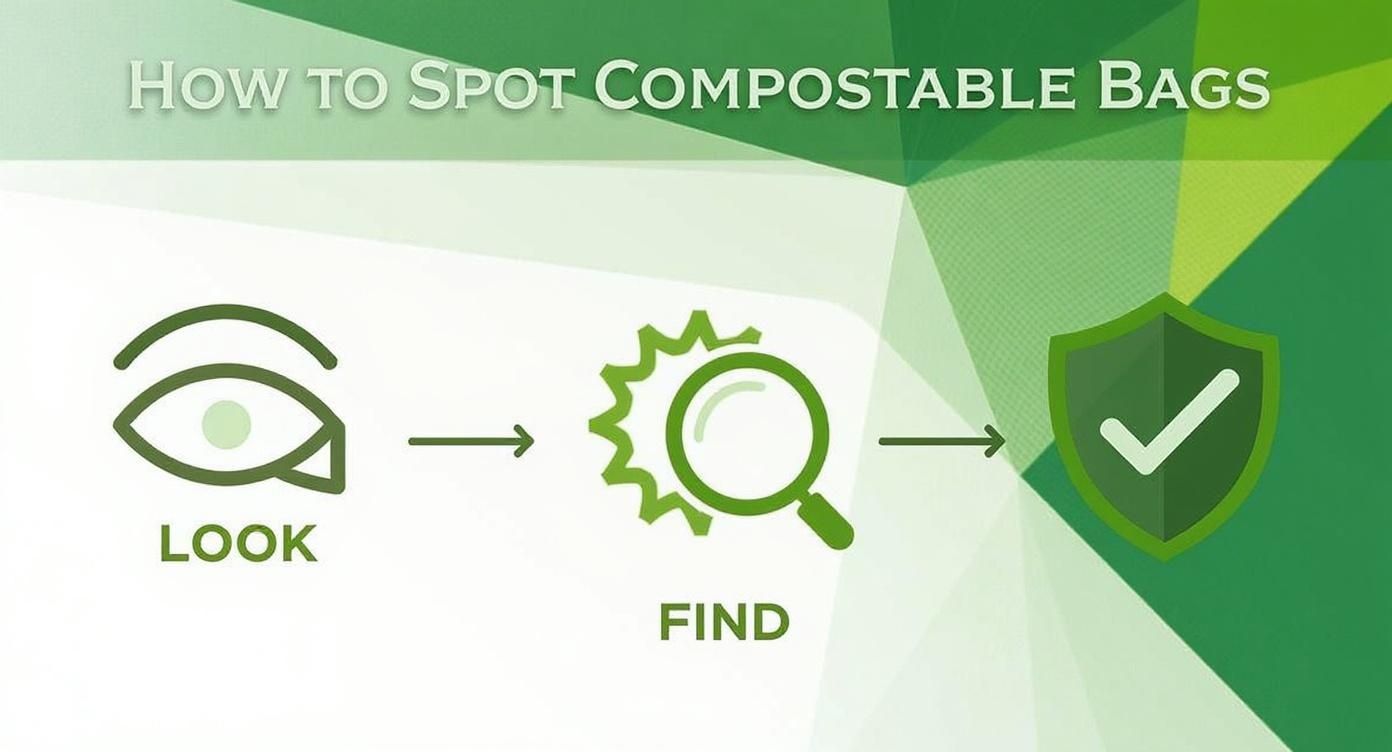
This visual is a great reminder that verifying certification is the first step to successful composting.
Finding a Composting Service Near You
Okay, let's get practical: how do you get your used bags to the right place? More and more U.S. cities and private companies are offering curbside compost pickup, just like they do for recycling. The growing demand is driving the market forward.
In fact, the market for compostable and biodegradable refuse bags was valued at USD 366.5 million and is expected to hit USD 756.3 million by 2035. The popular 7 to 20-gallon sizes, perfect for kitchen bins, are projected to grab over 42% of the market share—a clear signal of how many households are joining the composting movement. You can read a full analysis about the growth of the compostable bags market.
To find a service in your area, here are a few things to try:
- Check your city or municipality’s waste management website. They’ll have all the info on local green bin programs.
- Search online for "compost pickup service near me." Lots of private companies now offer subscription services.
- Use a composting locator tool. Websites like Litterless or CompostNow can help you find drop-off locations or pickup services in your neighborhood.
By taking a few minutes to find the right disposal option, you close the loop and ensure your compostable sandwich bags fulfill their promise of returning to the earth.
Compostable vs. Biodegradable vs. Recyclable
https://www.youtube.com/embed/idfCcEuCxs8
Trying to choose eco-friendly products can feel like learning a new language. You see words like "compostable," "biodegradable," and "recyclable" everywhere, and it's easy to assume they all mean the same thing. They don't—not even close.
Mastering these terms is the key to making choices that actually help the planet.
Let's break it down with a simple analogy. Think of an apple core. Toss it in the right environment, and it becomes healthy soil. That's compostable. Now, picture a log in the forest. It will eventually break down, but it could take a lifetime. That's biodegradable. And finally, an aluminum can. It can be melted down and forged into a new can. That's recyclable.
Each word describes a completely different fate for a product. You can't just swap one for another.
Understanding Your Eco-Friendly Options
To make it crystal clear, let's look at these terms side-by-side. This table breaks down what each label truly means for you and the environment.
| Term | What It Means | How It Breaks Down | Best For |
|---|---|---|---|
| Compostable | The product will break down completely into natural, non-toxic elements (like water and biomass) within a specific timeframe. | Decomposes in a controlled commercial composting facility (90-180 days) or a home compost pile, turning into nutrient-rich soil. | Food scraps, certified compostable bags, and other organic materials that enrich the soil. |
| Biodegradable | The product will eventually be broken down by microorganisms over time. | Can take anywhere from months to centuries. Often leaves behind microplastics and other harmful residues. There are no strict standards. | This term is too vague to be useful for most products. It's often used for marketing without any real environmental benefit. |
| Recyclable | The material can be collected, processed, and remade into new products. | Is melted, shredded, or reprocessed at a special facility. It doesn't break down naturally. | Glass, aluminum, cardboard, and specific types of rigid plastics (like bottles and jugs). |
As you can see, "compostable" is the only term that guarantees a product will return to the earth as a valuable, natural material in a timely manner.
H3: Biodegradable: A Vague Promise That Often Falls Short
The word biodegradable sounds wonderful, doesn't it? But in reality, it's often a misleading marketing buzzword. All it means is that something will eventually break down into smaller pieces with the help of microorganisms. The fatal flaw? There's no set timeline and no rules about what those "smaller pieces" can be.
A log is biodegradable, sure, but it might take 50 years. Worse, many plastics labeled "biodegradable" just crumble into tiny, toxic microplastics that persist for centuries, polluting our soil and water. Because the term is unregulated, it offers a false sense of doing good.
The key takeaway is this: "biodegradable" describes a natural process but doesn't guarantee a positive environmental outcome. Without a specific timeframe or conditions, the term is virtually meaningless for everyday products like sandwich bags.
If you want to explore more biodegradable products, you'll see how wide-ranging and confusing the term can be across different items.
H3: Recyclable: A Great System for the Right Materials
Recyclable means a material can be collected, processed, and turned into something new. This is a brilliant system for things like glass, aluminum cans, and certain hard plastics (like water bottles). It keeps valuable resources out of the landfill and in circulation.
But here’s the crucial catch: soft plastics, like your typical sandwich bag, almost never belong in your curbside recycling bin. They get tangled in the sorting machinery at recycling facilities, causing expensive shutdowns and contaminating entire batches of otherwise good materials. And you absolutely cannot recycle a compostable bag—it's made of organic material that would ruin the plastic recycling process.
H3: Compostable: The Gold Standard for Turning Waste into a Resource
This brings us to compostable, a much higher and more specific standard. A certified compostable product doesn't just break down; it completely disintegrates into non-toxic, natural elements—water, carbon dioxide, and biomass. In other words, it becomes nutrient-rich soil, or compost.
For a product to earn a "certified compostable" label in the U.S., it must meet strict scientific standards (ASTM D6400). This proves it will break down safely in a commercial composting facility in about 90-180 days. This carefully managed process turns our waste back into a valuable resource for farms and gardens. Our guide on compostable vs biodegradable bags provides a more detailed comparison if you're curious.
Choosing certified compostable bags means you’re plugging into a truly circular system—one where your daily habits help return nutrients to the earth, just like that apple core.
Got Questions About Compostable Sandwich Bags? We’ve Got Answers.
Making a change for the better, like switching to compostable bags, is a powerful move. But it's completely normal to have a few questions. After all, you deserve to know what you're buying and how it will perform in your daily life.
We've heard all the common questions, and we're here to give you straight, honest answers. Think of this as the final piece of the puzzle, empowering you to ditch single-use plastics with 100% confidence.
Are They As Strong As Regular Plastic Bags?
This is probably the number one question, and for good reason. No one wants a soggy sandwich or a trail mix explosion. The great news? Modern compostable bags are remarkably tough.
Thanks to an intelligent blend of plant-based materials like PLA and PBAT, these bags are built for real life. They easily handle moisture from sliced tomatoes and have enough flex to resist tearing, even when you’re in a rush. They might feel a little different—perhaps softer or less crinkly than plastic—but when it comes to performance, they absolutely hold their own for everyday use.
Let's cut to the chase: A well-made, certified compostable sandwich bag is absolutely strong enough for the job. It will keep your lunch fresh and secure, no compromises necessary.
Of course, they aren't designed for heavy-duty freezer storage or sharp objects. But for packing daily lunches and snacks? They are more than ready for the task.
Will They Start Breaking Down In My Pantry?
This is a common myth. The thought of your sandwich bags decomposing on the shelf is unsettling, but that’s simply not how they work. Compostable bags are engineered to break down only under very specific conditions—conditions you won’t find in your kitchen.
Think of an apple. On your counter, it stays fresh for days. But toss it into an active compost pile with the right mix of heat, moisture, and microbes, and it breaks down rapidly. Your compostable bags follow the same principle. They need the high heat (over 130°F), humidity, and hungry microorganisms of a commercial composting facility to activate their decomposition.
As long as you store them in a cool, dry place away from direct sun, they’ll remain perfectly stable and ready to use for at least a year. They won't get weak or sticky until they’re in the proper composting environment.
Are Compostable Bags More Expensive?
Let's talk price. Yes, compostable sandwich bags can cost a little more upfront than their plastic counterparts. But it’s essential to see that difference not as a cost, but as an investment in a healthier planet.
That slightly higher price tag reflects the product's entire sustainable journey:
- Renewable Resources: The materials are grown on farms, not drilled from finite oil reserves.
- Smarter Science: Turning plants into durable bioplastics is a more advanced process than outdated plastic manufacturing.
- Proven Performance: The price includes rigorous third-party testing and certifications from groups like BPI and CMA to guarantee they are truly compostable.
When you choose compostable, you're paying for a product that won't pollute our oceans or sit in a landfill for centuries. That small price difference supports a circular system that turns waste back into a resource. That’s an incredible return on investment.
Can I Use Them For Hot or Liquid Foods?
Compostable sandwich bags are best for what their name implies: sandwiches and other solid, room-temperature, or cool foods. They're perfect for packing snacks, fruit, veggies, and cookies.
However, they’re not built for hot foods or liquids. The plant-based materials, especially PLA, have a lower heat tolerance than petroleum plastic. Pouring hot soup or leftovers into the bag could cause it to warp or lose strength. Similarly, they aren't designed to be leak-proof for liquids.
For hot or soupy items, a reusable glass or stainless steel container is still your best bet. Let your compostable bags do what they do best: provide a convenient, eco-friendly way to pack your daily lunch and snacks.
Why Can’t I Just Throw Them In My Backyard Compost?
This is a fantastic question that gets to the heart of how these products work. While some very thin compostable films are certified for home composting, most durable sandwich bags require the high-intensity environment of an industrial facility to break down properly.
Your backyard compost pile is great for kitchen scraps and yard trimmings, but it simply doesn't get hot enough, for long enough, to break down bioplastics like PLA. A home pile might hit 110-120°F on a warm day, but these bags need sustained temperatures of 131°F or higher to fully decompose within the 90-180 day window.
If you toss one of these bags in your backyard bin, it will likely sit there for a very long time—not much better than plastic litter. To ensure it completes its journey back to the earth, it must go to a commercial or municipal composting facility that has the heat and conditions it needs to transform.
Ready to make a confident switch to a greener lunch routine? With terravera, you get premium, BPI & CMA certified compostable sandwich bags that are as strong as they are sustainable. Join the thousands of others making a practical choice for a healthier planet.
Explore our full range of compostable solutions at https://www.myterravera.com and pack your lunch with purpose.