

Make Every Walk Count: Why Compostable Pet Waste Bags Are a Non-Negotiable Choice for Conscious Pet Owners
Every single time you walk your dog, you're faced with a choice. It might seem small, but the bag you use to clean up after them has a ripple effect that lasts for centuries. Grabbing a standard plastic bag is a habit, but it's a habit that contributes to a staggering amount of permanent pollution. The simple, powerful decision to switch to certified compostable pet waste bags is one of the most impactful choices you can make to protect our planet—and it couldn't be easier.
The Small Change That Makes a World of Difference
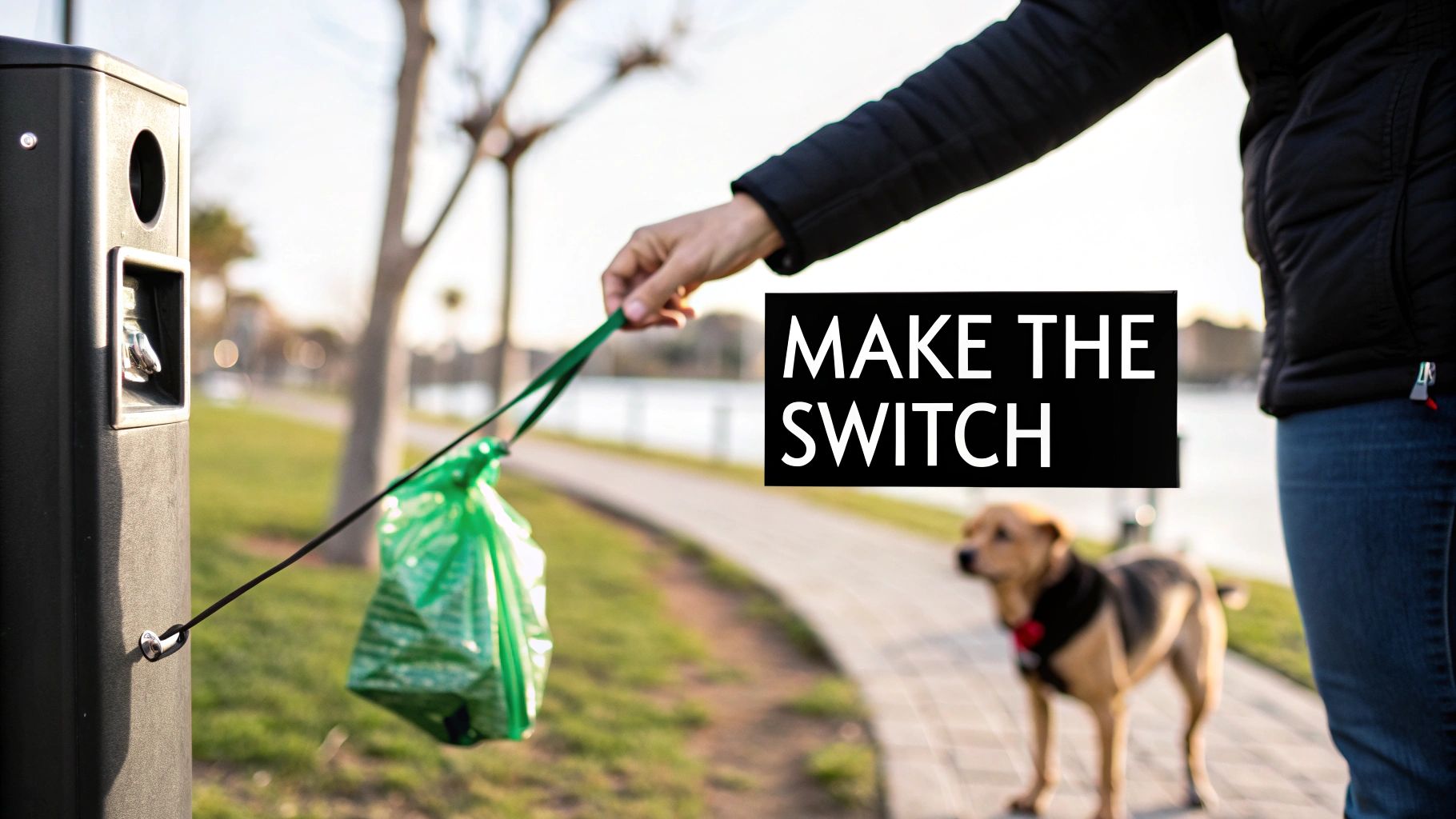
Picking up after your dog is a small, routine act. But when you multiply that single action by millions of responsible pet owners across the globe, every single day, the environmental consequences become monumental. Those familiar plastic bags are derived from fossil fuels and are engineered to last forever. They will sit in landfills for hundreds of years, long after we're gone, slowly fragmenting into toxic microplastics that poison our soil and waterways. It’s a one-way ticket to permanent pollution.
This is where compostable bags completely change the game. Instead of creating waste that outlives us all, these bags are designed to become part of the earth again. Imagine a regular plastic bag as a stone you throw into a garden—it will sit there, unchanged, for generations. A certified compostable bag is like an apple core; it nourishes the soil, breaks down completely, and disappears without a trace. It’s not just a bag; it's a promise of a cleaner future.
Why This Shift Is an Urgent Necessity
The global movement away from single-use plastics isn't just a trend; it's a critical response to a planetary crisis. This growing awareness is fundamentally reshaping consumer behavior and market demands.
The global demand for compostable pet waste bags is skyrocketing, and it's a powerful signal. It reflects a collective awakening to the damage caused by single-use plastics and a shared desire for smarter, kinder solutions. This isn't just about feeling good—it's about taking meaningful action with every purchase.
This surge in demand is driving innovation, making superior, eco-friendly options more accessible and affordable than ever before. The global market for these bags, recently valued at around $500 million, is projected to grow at a compound annual rate of 8% through 2033. You can explore the data behind this growth at archivemarketresearch.com. This is no longer a niche market; it's the future.
More Than Just a Bag
Choosing compostable bags is about aligning your daily actions with your values. It’s a simple, effortless step that proves your commitment to environmental stewardship without sacrificing convenience. You get the strong, reliable, and leak-proof performance you demand, but without the devastating, centuries-long environmental cost.
This guide will show you exactly why this small change is so powerful, empowering you to make a choice that truly matters.
What 'Compostable' Actually Guarantees for Your Dog's Poop Bags
In a world saturated with "green" marketing, it’s easy to feel lost. You see vague, feel-good terms like "biodegradable," "earth-friendly," and "eco-safe" everywhere. But these labels are often meaningless, designed to confuse rather than clarify, leaving you unsure if you're truly making a responsible choice.
It's time to cut through the noise. Let’s talk about what certified compostable actually means—and why it's the only standard that counts.
Picture a standard plastic bag. It’s a zombie product. For hundreds, even thousands of years, it will haunt our planet. It may break down into smaller pieces, but it never truly disappears. It just becomes toxic microplastic pollution, contaminating our soil, our oceans, and ultimately, our bodies. Sadly, this is the fate of many products deceptively labeled as "biodegradable."
Now, imagine a certified compostable pet waste bag. This isn't just a bag; it's a biological nutrient. In a proper composting environment, it doesn’t just fragment. It undergoes a complete transformation. Microorganisms feast on the plant-based material, breaking it down into its fundamental, earth-friendly components: water, carbon dioxide, and nutrient-rich compost.
The crucial difference lies in the legacy left behind. A plastic bag leaves a permanent scar of pollution. A genuinely compostable bag leaves nothing but healthy soil, completing a perfect, natural cycle from plant back to earth.
How Does a Poop Bag Magically Turn into Soil?
How can something strong enough to handle its messy job just vanish back into nature? The magic is in the science. Certified compostable bags are made from renewable, plant-based materials—most commonly cornstarch, known as Polylactic Acid (PLA).
Unlike petroleum-based plastic, PLA is a five-star meal for the microbes in a compost pile. To kickstart the decomposition process, these microorganisms need a specific recipe:
- Heat: Industrial composting facilities maintain temperatures between 130-160°F (55-70°C) to accelerate the breakdown.
- Moisture: Water is essential for the microbes to do their work effectively.
- Oxygen: Aerating the compost pile fuels the right kind of bacteria and prevents the release of methane, a potent greenhouse gas.
This controlled environment ensures the bags decompose completely within a specific timeframe, typically 90-180 days, leaving zero toxic residue. The chasm between a vague "biodegradable" claim and a certified "compostable" guarantee is enormous. You can learn more about these critical differences between compostable and biodegradable bags.
Why Certification Is Your Only Guarantee of Truth
Because "compostable" is a scientific process with a specific outcome, it's not a term that any company can just claim. Trustworthy products must undergo rigorous testing by independent organizations to prove they meet strict international standards. If you want to be certain you're buying truly compostable pet waste bags, you must look for the official certification logos.
These certifications are your non-negotiable proof that the product delivers on its promise. The most respected certifications to demand are:
- BPI (Biodegradable Products Institute): This is the gold standard in North America. The BPI logo is your assurance that the product meets ASTM D6400 standards for complete decomposition in a commercial compost facility.
- TÜV AUSTRIA (OK compost HOME & OK compost INDUSTRIAL): This European certification is globally recognized. The "OK compost HOME" seal is a significant advantage, proving the product can break down even in the lower temperatures of a backyard compost bin.
Learning to spot these logos is like learning to read a nutrition label. Just as you want to understand the truth behind claims like natural dog food preservatives, you need to know what a compostable certification truly represents. Without these official seals, you're almost certainly buying plastic with a green-washed lie on the box.
The Environmental Aftermath of Your Daily Walk
Every walk you take with your dog is a decision point, a moment that leaves a lasting mark. The bag you choose determines the kind of legacy you and your pet leave behind. The difference between a standard plastic bag and a certified compostable pet waste bag isn't just about material; it's about two fundamentally different stories with two drastically different endings.
The story of a plastic bag is a tragedy. It begins with drilling for finite fossil fuels. Its creation is an energy-intensive process that pollutes our air. Its entire existence is designed for a single use, followed by an eternity of waste. When you throw it away, it is entombed in a landfill where it will persist for over 500 years.
But it doesn't just sit there. It actively harms our planet by breaking down into microplastics, tiny toxic particles that infiltrate our ecosystems, poisoning wildlife and contaminating our water supply. A moment of convenience creates a problem that will last for generations.
A Cleaner, Circular Future
Now, contrast that with the lifecycle of a certified compostable bag. Its story begins with renewable plants like corn, immediately slashing its carbon footprint. It’s a story of regeneration.
When disposed of correctly in a commercial composting facility, it doesn't become waste—it becomes a resource. Microorganisms transform it back into its natural components: water, CO2, and humus, a nutrient-rich compost that enriches the soil. This is the definition of a circular economy, where waste is designed out of the system.
This infographic powerfully illustrates the stark contrast and makes it clear why "certified compostable" is the only choice that truly benefits our planet.
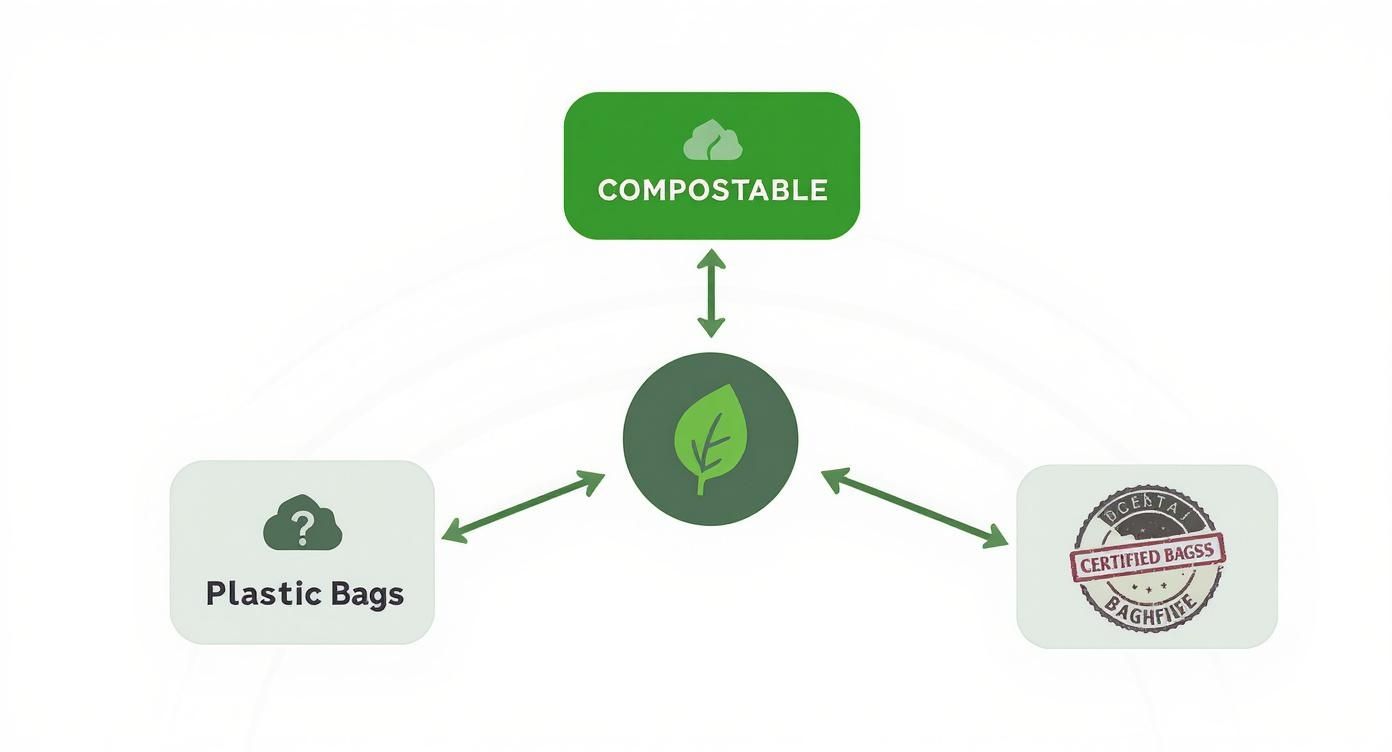
Compostable bags are part of a healing, regenerative cycle. Plastic bags are a dead end, a final chapter of pollution.
The Choice Is Stark: A Side-by-Side Comparison
Let’s lay it out in black and white. When you see the facts side-by-side, the right choice becomes undeniable.
Compostable vs. Plastic Pet Waste Bags
| Feature | Compostable Pet Waste Bags | Traditional Plastic Bags |
|---|---|---|
| Material Source | Made from renewable, plant-based resources like cornstarch (PLA). | Made from finite, polluting fossil fuels like petroleum. |
| End of Life | Becomes nutrient-rich, non-toxic compost in a commercial facility. | Persists for 500+ years in landfills, creating microplastic pollution. |
| Environmental Impact | Reduces greenhouse gas emissions and returns valuable nutrients to the soil. | Contributes to landfill overflow and long-term environmental toxicity. |
| Decomposition Time | Decomposes in approximately 90-180 days under correct composting conditions. | Takes centuries to degrade, never fully disappearing. |
| Resource Cycle | A circular model that turns "waste" back into a valuable resource. | A linear "take, make, dispose" model that creates permanent waste. |
The evidence is overwhelming. You are choosing between a product designed to work with nature and one that works against it.
This shift isn't just a wish; it's a reality. The global market for compostable and biodegradable dog poop bags, valued at $4.2 billion, is projected to soar to $8.7 billion by 2033. North America is leading this charge, accounting for $1.7 billion of that market. This explosive growth, detailed by DataHorizzon Research, is driven by informed consumers like you.
By choosing a certified compostable bag, you are actively rejecting the status quo of pollution. You are not just cleaning up after your pet; you are casting a vote for a healthier planet, preventing one more piece of plastic from poisoning our world.
Your daily walk is an opportunity. It is your chance to turn a simple chore into a powerful act of environmental stewardship.
Your Responsibility Doesn't End at the Bin: Proper Disposal of Compostable Bags
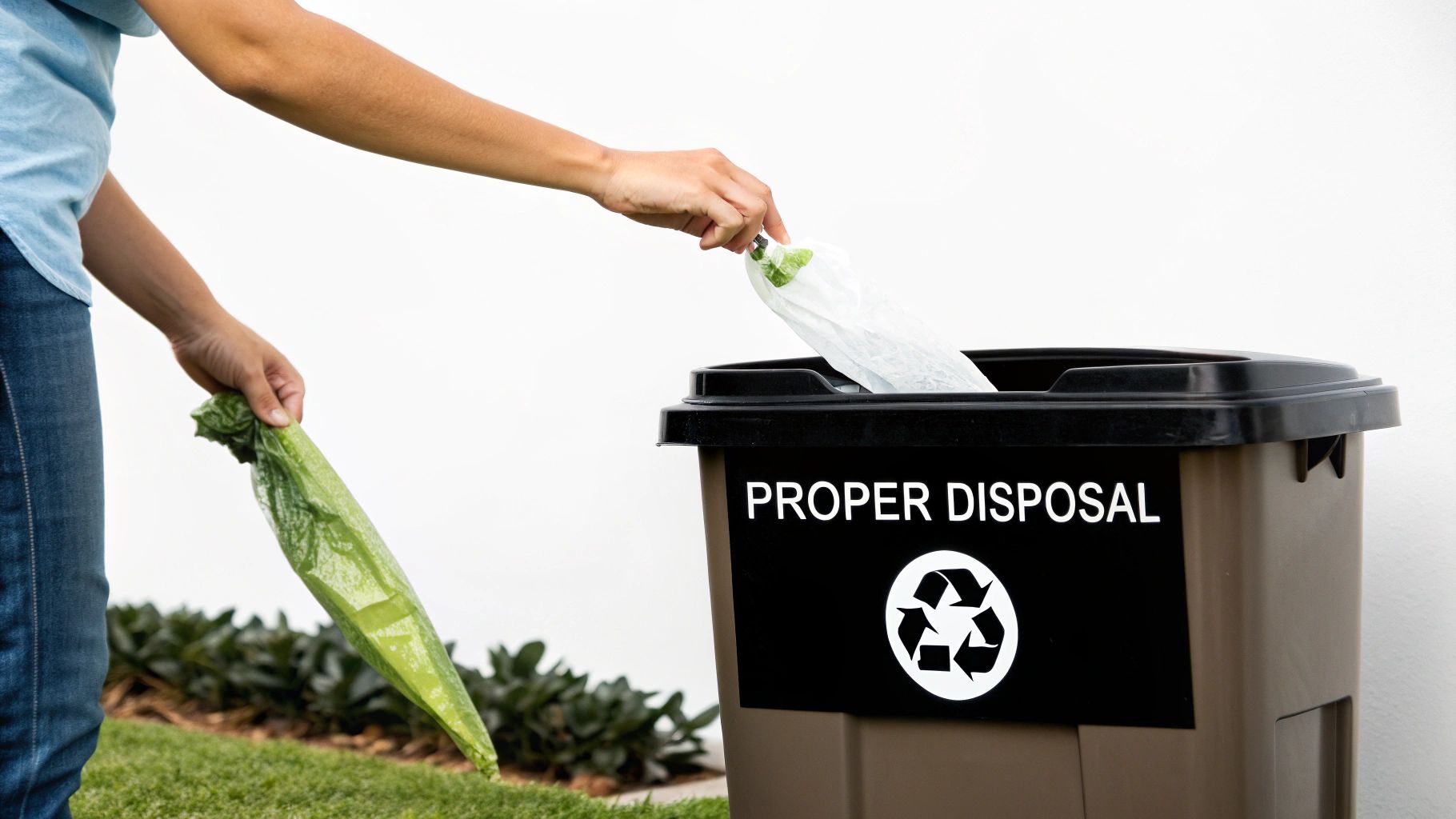
Congratulations on making the switch to compostable pet waste bags. You've chosen the right tool for the job. But owning the tool is only half the battle—you have to use it correctly. How you dispose of that bag is just as critical as the bag itself.
A compostable bag is like a key designed for a specific lock: the composting process. Tossing that key into a regular trash can or recycling bin is like throwing it into the ocean. Its potential is wasted, and the environmental benefits are never unlocked. Proper disposal is what completes the cycle.
Following the rules is also a matter of civic duty. Familiarizing yourself with local regulations, like the Dubai Municipality's pet laws on waste, ensures you're a responsible member of your community.
Industrial Composting: The Gold Standard
The ideal destination for your used compostable bags is an industrial or commercial composting facility. These facilities are masters of decomposition. They create the perfect storm of intense heat, moisture, and oxygen that materials like PLA need to break down rapidly and safely.
Most certified compostable bags are engineered for these high-temperature environments, where they can fully decompose in as little as 90 days and transform into valuable, nutrient-rich soil. It's the perfect circular solution.
How do you access this option?
- Check with your municipality. See if your city's green bin program accepts pet waste. Be aware that most do not due to concerns about pathogens. Always verify their specific guidelines.
- Search for private services. A growing number of private companies offer specialized pet waste composting services. A quick search for "pet waste composting near me" is your best starting point.
- Connect with your community. Local farmers' markets can be a surprising resource. Vendors often have direct relationships with commercial composters and can guide you.
Can You Compost at Home? Yes, But With a Critical Warning.
Home composting is a fantastic way to reduce waste, but it requires caution. Your backyard compost pile will not reach the high temperatures of an industrial facility. This means you must use bags specifically certified for "home composting" (like those with the TÜV AUSTRIA OK compost HOME seal), which are designed to break down at lower temperatures.
Even with the right bag, there is one non-negotiable safety rule:
Never use compost containing pet waste on any plants you intend to eat. Dog and cat feces can contain harmful pathogens that pose a health risk. This compost is safe only for non-edible plants like ornamental flowers, shrubs, and trees.
Mastering home composting takes a bit of effort. To learn how to create the perfect compost pile in your backyard, explore our comprehensive guide on how to compost at home.
Disposal Mistakes That Undermine Your Efforts
Knowing what not to do is just as important. Avoid these common errors to ensure your good intentions translate into positive impact.
- Never recycle it. This is a critical mistake. Compostable bags are contaminants in the plastic recycling stream, ruining entire batches of recyclable materials.
- Never flush it. These bags are not water-soluble. Flushing them will cause severe plumbing and sewer blockages.
- Never leave it in nature. A compostable bag left on a hiking trail is still litter. It requires the specific conditions of a compost pile to break down and will not simply biodegrade on its own.
When Landfill Is Your Only Choice...
What if you have no access to composting facilities? While not ideal, sending a compostable bag to a landfill is still a significantly better choice than using conventional plastic.
Here’s why: a compostable bag is made from renewable plants, not fossil fuels, giving it a much lower carbon footprint from the start. Crucially, it will not shed toxic microplastics for centuries like a traditional plastic bag. While the anaerobic conditions of a landfill will slow its decomposition, you have still chosen a product with a cleaner, more responsible lifecycle.
How to See Through the Greenwashing and Find Genuinely Eco-Friendly Products
Walking down the pet aisle, you're bombarded with marketing buzzwords. Packages adorned with green leaves shout "earth-friendly," "eco-safe," or "green." These terms sound reassuring, but they are often completely meaningless.
This deceptive practice is called greenwashing. It's a marketing strategy designed to mislead you into believing a product is more environmentally sound than it really is. It preys on your good intentions. But you don't need to be an expert to see through the deception. The key is to ignore the empty slogans and demand concrete proof.
The Logo Is the Law: Your Guarantee of Authenticity
The single most critical element to look for on a package of compostable pet waste bags is an official certification logo. This logo is not a marketing gimmick; it is a legally binding guarantee that the product has passed rigorous scientific testing and is proven to decompose completely in a composting environment.
Think of it this way: you trust that a food is organic because you see the official USDA seal, not because the box has a picture of a farm on it. The same principle applies here. These certifications are your shield against false claims.
Demand to see one of these top-tier certifications:
- BPI (Biodegradable Products Institute): The leading authority in North America. Its logo is your assurance that the bags meet the stringent ASTM D6400 standard for commercial composting.
- TÜV AUSTRIA (OK compost HOME & OK compost INDUSTRIAL): A globally respected European certification. The "OK compost HOME" seal is the gold standard for backyard composters, guaranteeing the bag will break down in lower-temperature home piles.
When you choose a product bearing one of these logos, you are moving beyond hope and into certainty. You are choosing a product that is verified to be part of the solution. It is the only way to make a truly informed and responsible choice.
Beyond Certification: Practicality Matters
Once you've verified a bag's compostable credentials, a few practical features ensure it will work seamlessly in your daily life. A product isn't truly sustainable if it's a pain to use.
A flimsy, unreliable bag is useless, no matter how eco-friendly it claims to be. You can dive deeper into what makes a compostable bag truly perform in our article that asks, "Are compostable bags really compostable?".
Here are the other factors to consider:
- Strength and Durability: No one wants a leak or a tear. Look for information on the bag's thickness (measured in microns) and check reviews that confirm its durability. A quality compostable bag is every bit as strong as its plastic counterpart.
- Size and Dispenser Fit: Ensure the bags are large enough for your breed of dog and that the rolls are compatible with your favorite leash dispenser.
- Shelf Life: Because they are made from organic materials, compostable bags have a shelf life of around 12 months. Store them in a cool, dark, and dry place to maintain their integrity.
The demand for genuinely sustainable products is reshaping the market. While the overall pet waste bag market is set to grow from $44.8 billion to $62.6 billion by 2033, the eco-friendly segment is growing more than twice as fast. This powerful trend proves that consumers like you are demanding better from brands.
Your Questions, Answered.
Making a change, even a small one, naturally comes with questions. You need to be confident that these bags are up to the task. Let's tackle the most common concerns head-on so you can make the switch with total peace of mind.
Are These Bags Really as Strong as Plastic?
Yes. Unquestionably. The idea that "eco-friendly" means "weak" is a persistent myth. High-quality certified compostable bags are engineered from durable, plant-based biopolymers like cornstarch. They are designed and tested to be just as strong, puncture-resistant, and leak-proof as the petroleum-based plastic bags you've always used.
The difference isn't in their performance during your walk—it's in their performance after you dispose of them. You get all the strength you need, without leaving behind a toxic legacy.
What Is the Real Difference Between "Biodegradable" and "Compostable"?
This is the most critical distinction, and it's where most greenwashing occurs. "Biodegradable" is a hollow, unregulated term. It simply means something will break down eventually—but it doesn't specify how long it will take or what it will break down into. Many so-called "biodegradable" plastics simply fragment into harmful microplastics.
"Compostable," however, is a legally defined, scientific standard. To earn this certification, a product must be proven through rigorous testing (like the ASTM D6400 standard) to completely and safely break down into non-toxic, natural elements within a specific timeframe in a composting environment.
Think of it this way: "biodegradable" is a vague marketing promise. "Certified compostable" is a scientific guarantee. Your only assurance of a truly eco-friendly product is the certification logo.
Do Compostable Bags Expire?
Yes, they do—and that's a feature, not a flaw. It's definitive proof that they are made from organic materials designed to return to the earth. Most compostable bags have a shelf life of 12 to 18 months, giving you ample time to use them at their maximum strength.
To ensure your bags remain durable, simply store them properly:
- Keep them in a cool, dry place away from moisture.
- Store them out of direct sunlight, as UV exposure can initiate the decomposition process.
- Avoid extreme heat, which can weaken the material.
Just treat them like any other pantry staple and buy only what you expect to use within a year.
Can I Just Toss These in My City's Green Bin?
This is a crucial question, and the answer is almost always no. Most municipal composting programs do not accept pet waste due to the potential for harmful pathogens that their systems may not be equipped to eliminate.
You must check the specific guidelines for your local waste management service. Never assume pet waste is acceptable in your green bin.
The same rule applies to your backyard compost. You should never add pet waste to a compost pile used for edible gardens. If you wish to compost pet waste at home, you must maintain a separate, dedicated system, and the resulting compost should only be used on non-edible, ornamental plants.
Making the switch to certified compostable bags is a simple, powerful, and reliable choice. It's a small adjustment to your daily routine that creates a massive positive impact for our planet.
Ready to make a change that matters? With terravera, you get the uncompromising strength you need in a bag that's guaranteed to return to the earth. Make every walk a vote for a cleaner world.
Shop our certified compostable pet waste bags at myterravera.com