

Compostable Bags vs. Biodegradable Bags: Which Choice Truly Matters?
Let's cut through the confusion. The critical difference between compostable and biodegradable bags isn't just a technicality—it's the entire story. Compostable bags are engineered to transform into nutrient-rich soil within a specific, verified timeframe. Biodegradable bags, on the other hand, simply break apart into smaller, often harmful, pieces over an unknown and unregulated timeline.
Here’s the absolute truth: all compostable bags are biodegradable, but almost no biodegradable bags are compostable. Understanding this isn't just smart; it's the only way to make a choice that genuinely benefits our planet.
Unmasking the Core Differences
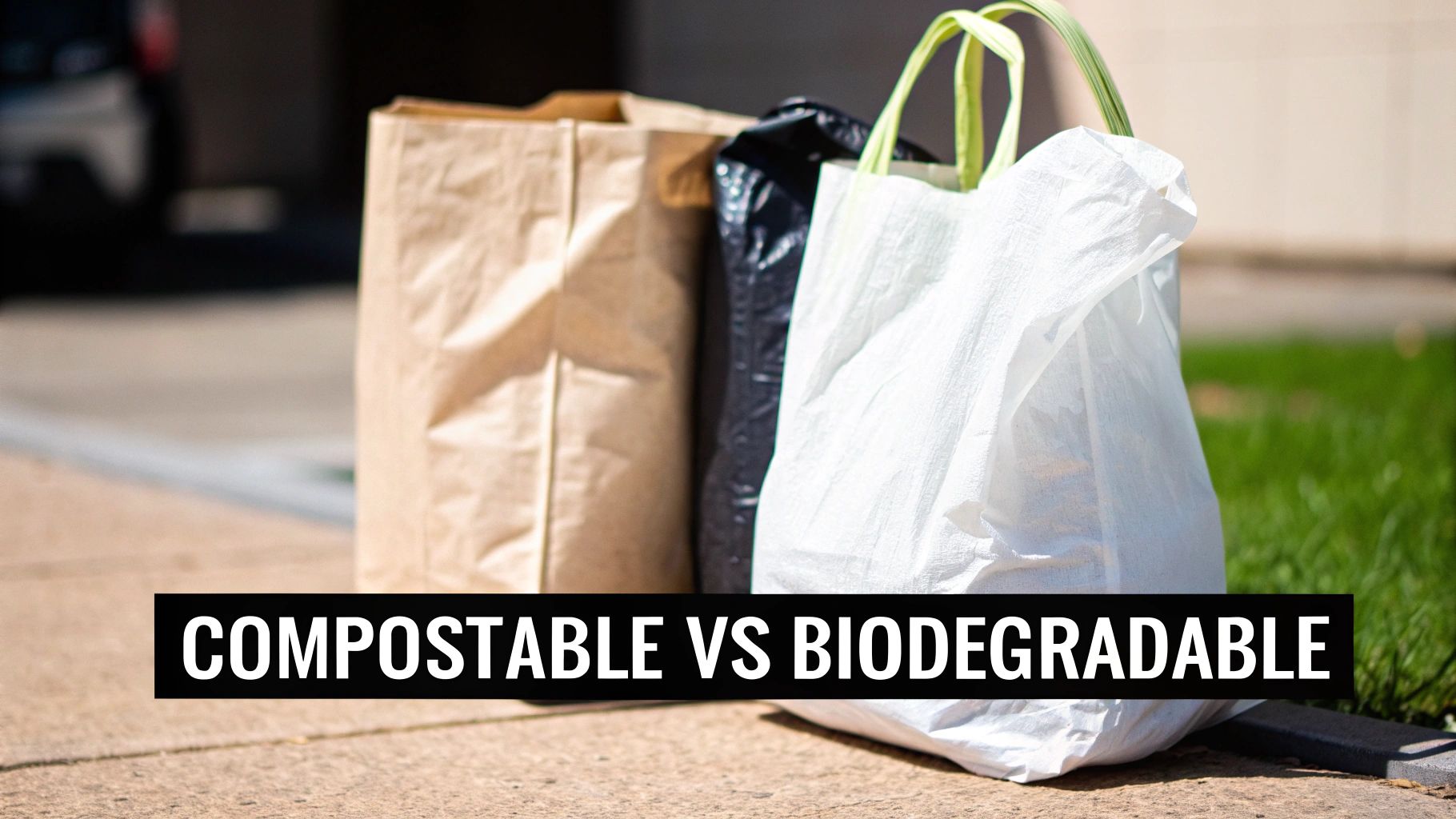
Standing in the store, it's easy to be misled. The packaging looks the same, the green-leaf logos are everywhere, and the promises feel interchangeable. But "compostable" and "biodegradable" describe two completely different fates for a product, with profoundly different impacts on the Earth. If you want to be part of the solution, you must know what sets them apart.
The term "biodegradable" sounds wonderful, but it has become one of the most deceptive marketing claims on the market. It means nothing more than an item can be broken down by microorganisms. The fatal flaw? The label doesn't tell you how long it will take or what it becomes. Many so-called "biodegradable" plastics do little more than crumble into invisible microplastics, poisoning our soil and waterways for generations.
In stark contrast, "compostable" is a regulated, scientific, and certified term. For a bag to earn this label in the United States, it must pass rigorous standards like ASTM D6400.
This certification is a non-negotiable promise that the bag will:
- Break down completely into carbon dioxide, water, and organic biomass.
- Decompose at the same rate as natural materials like leaves and food scraps.
- Leave zero toxic residue behind, creating a nutrient-rich compost that actively heals the soil.
Let’s be clear: "compostable" is a guarantee of environmental performance. "Biodegradable" is often just a hollow marketing term. It is the crucial difference between genuinely returning to the earth and just vanishing from our sight.
Core Differences Compostable vs Biodegradable Bags
This side-by-side comparison makes the choice starkly clear. One is a verified process; the other is a gamble with our planet's health.
| Attribute | Compostable Bags | Biodegradable Bags |
|---|---|---|
| Breakdown Process | Decomposes into organic matter (humus) under specific, controlled conditions. | Breaks down through microbial action over an undefined, often endless, period. |
| End Product | Nutrient-rich compost, water, and CO2. No toxic residue. | Can fragment into microplastics and may leave toxic chemicals behind. |
| Required Conditions | Need the high heat and humidity of an industrial compost facility to work. | Conditions are a mystery; fails to break down in oxygen-starved landfills. |
| Timeline | Must disintegrate within a set timeframe (90-180 days). | No defined timeline; could take centuries to fully break down. |
| Regulation & Certification | Governed by strict standards like ASTM D6400 and certified by bodies like BPI. | Almost entirely unregulated, leading to rampant greenwashing. |
As you can see, one is a certified standard you can put your faith in. The other is a vague claim that often betrays our trust. Choosing compostable isn't just a preference; it's a commitment to a product with a verified, responsible end-of-life plan.
The Unseen Journey: How These Bags Truly Break Down
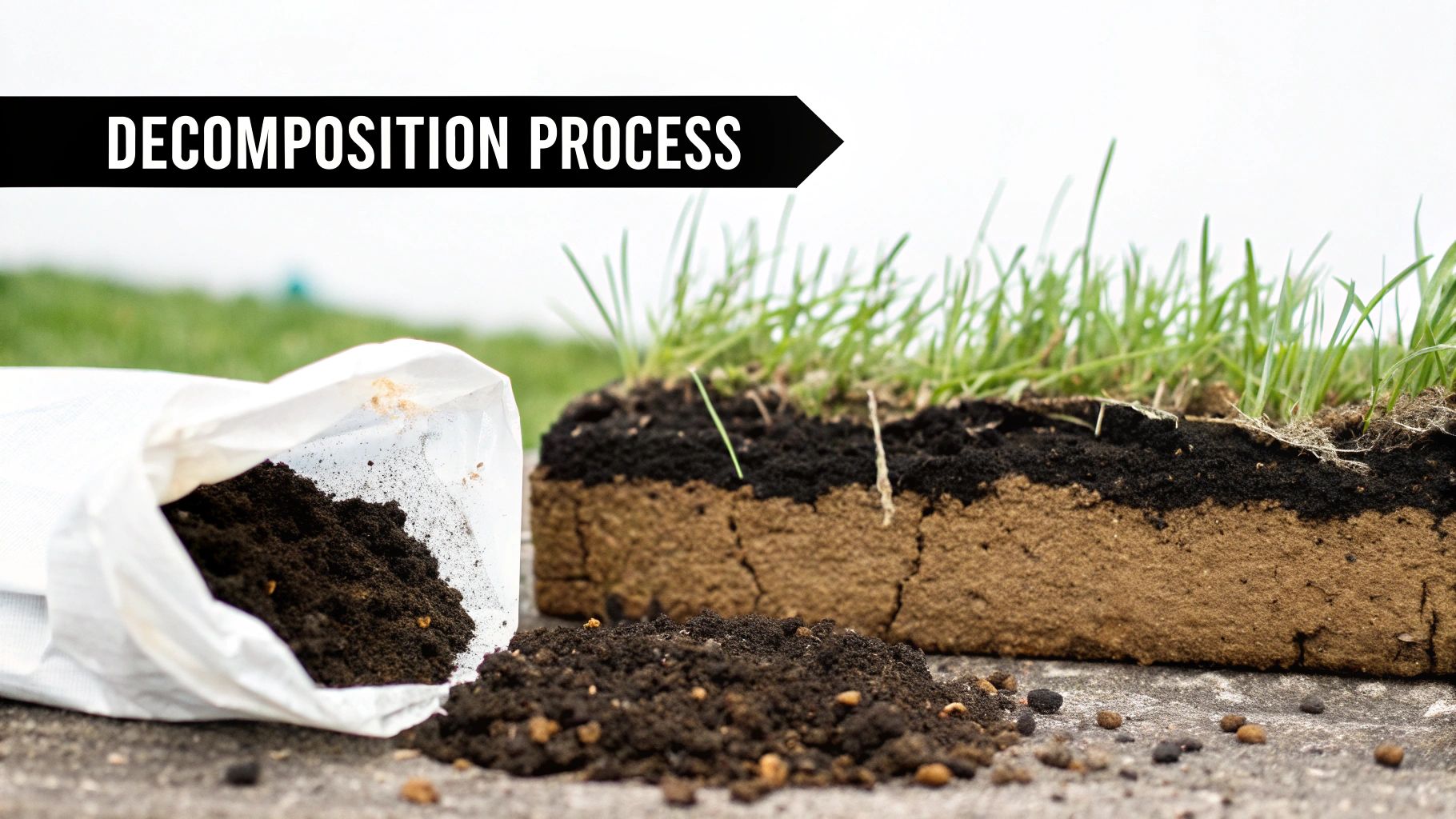
What happens after you throw a bag away is the only thing that matters. This is the heart of the compostable vs. biodegradable debate. One process is a controlled, regenerative cycle. The other is a slow, toxic path that leads to more pollution. The science doesn't lie—these two terms are worlds apart.
A certified compostable bag isn't designed to disappear; it's engineered to become part of the earth again.
The Controlled Cycle of Compostable Bags
Think of a compostable bag as an apple core. In the right environment, it doesn’t just vanish—it transforms into a valuable resource that enriches the soil. But that magical transformation requires a specific recipe of intense heat, moisture, and hungry microorganisms.
For this miracle to happen, the bag must reach an industrial composting facility. These are not simple piles; they are carefully managed bioreactors that maintain scorching temperatures—often between 130°F and 160°F—and control airflow. This creates a five-star resort for microbes to do their work.
In this controlled setting, a certified compostable bag will:
- Decompose into humus, the rich, dark organic matter that gives soil life.
- Break down into simple, harmless elements like water and carbon dioxide.
- Complete this entire process in under 180 days, leaving absolutely no toxic residue.
It’s a true closed-loop system, turning what was once waste back into a vital resource. These bags are made from materials specifically designed for this outcome, which you can learn more about in this article on what compostable bags are made of.
The Uncertain Fate of Biodegradable Bags
The story for a "biodegradable" bag is a tragedy of good intentions. The term itself is so ambiguous that it offers no guarantee of a positive outcome. It simply means the material can be broken down by living organisms—but that's a promise without a plan.
When a biodegradable bag ends up in a landfill—the destination for most of our trash—it enters a toxic tomb. Landfills are packed so tightly they are starved of oxygen, a key ingredient for anything to break down cleanly.
In this anaerobic (oxygen-free) hellscape, a biodegradable bag will likely:
- Sit there for hundreds of years, mummified and behaving exactly like a conventional plastic bag.
- Slowly fragment into smaller and smaller microplastics that contaminate our soil and water forever.
- If it does manage to break down without oxygen, it will release methane, a greenhouse gas far more destructive than carbon dioxide.
This lack of a clear path is the central deception. The "biodegradable" label offers false comfort, while the reality is just a different kind of permanent pollution. To understand how things should return to the earth, you can explore the principles of biodegradable packaging.
Here's the crucial takeaway: Certified compostable products are designed to complete a natural cycle and enrich the soil. In contrast, many items labeled "biodegradable" simply break up into smaller, persistent pollutants that harm our environment.
The difference in their breakdown process is profound. One follows a structured path to becoming a resource. The other stumbles down a random path to becoming a long-term problem. That distinction is everything when deciding which bag is truly better for our planet.
Decoding the Labels: Your Defense Against Greenwashing
You walk down the aisle and are hit with a tidal wave of green leaves and earthy-toned packaging. Every product screams that it's good for the planet. But when it comes to compostable vs. biodegradable bags, marketing is a minefield of misinformation. The secret to navigating it? Ignore the slogans. The real story is in the small, official, third-party certification logos on the box.
Think of certifications as your armor. They are an independent, scientific seal of approval, confirming that a product has been rigorously tested to break down properly and safely. Without them, you are simply trusting a company’s marketing department with the health of our planet.
Why Certifications Are Non-Negotiable
A certification is proof. It is the dividing line between a bag that is "probably eco-friendly" and one that is "verified to be." For compostable products, this verification is absolutely critical. It ensures the bag will perform its duty in a commercial composting facility without causing chaos.
If a non-certified bag contaminates a composting stream, it can ruin an entire batch of valuable compost with plastic fragments. Certifications protect the entire system, hold manufacturers accountable, and empower you to make choices that deliver a real, positive impact.
The Gold Standard: ASTM D6400 and BPI
When you pick up a package of compostable bags, burn these two names into your memory. They are the only credible signs that a product is the real deal for commercial composting.
-
ASTM D6400: This is the scientific standard from ASTM International. It is the rulebook, laying out the non-negotiable requirements a plastic product must meet to be called "compostable" in an industrial facility. It covers everything from breakdown speed to ensuring it leaves no toxic residue.
-
BPI (Biodegradable Products Institute): BPI is the certifying body that enforces the standard. They test products against ASTM D6400. Seeing the BPI Certified Compostable logo is your clearest, most reliable sign of a genuinely compostable product. It’s a simple visual promise that the bag has passed every scientific test.
The BPI logo isn't just a pretty symbol; it's a promise. It guarantees the bag will break down safely within 180 days in a commercial facility, turning into nutrient-rich compost without leaving microplastics or toxins.
Recognizing Misleading Labels
The term "biodegradable" is so poorly regulated it has become a greenwasher's dream. Companies use eco-friendly colors and images of leaves to imply an environmental benefit that doesn't exist. You must be skeptical of these vague claims. For a deeper dive into these terms, check out our guide on the difference between compostable and biodegradable.
Arm yourself against deception by watching for these red flags:
- Vague terms like "eco-friendly," "earth-friendly," or "green" without any certification to back them up.
- Products labeled "biodegradable" with no specifics on timeline or conditions.
- Claims of being "plant-based" without a BPI certification. A bag can be made from corn and still fail to compost properly.
Ultimately, your power is in knowing what to demand. By focusing on credible, third-party certifications like the BPI logo, you can cut through the marketing noise and choose products that genuinely align with your values. The certification tells you the true destiny of that bag.
Your Guide to Proper Disposal: Where the Real Impact Happens
Choosing the right bag is only half the battle. The real environmental impact of your choice—whether compostable or biodegradable—is sealed the moment you throw it away. Getting the disposal right is absolutely everything.
If you fail here, you risk doing more harm than good. A certified compostable bag is designed to heal the soil, but if it ends up in the wrong place, it's just another piece of trash.
The Correct Path for Compostable Bags
Certified compostable bags are made for one specific destination and one only: an industrial composting facility. These are highly controlled environments, and they're the only places where these bags can fulfill their environmental promise.
Here’s why that matters so much:
- Heat is Everything: Commercial facilities operate at scorching temperatures of 130°F to 160°F. This intense heat is essential to break down bioplastics like PLA. Your backyard compost pile simply cannot get that hot, meaning a compostable bag will sit there for months or even years, instead of breaking down in the required 90-180 days.
- Don't Contaminate Recycling: Never, ever put a compostable bag in your recycling bin. Though they feel like plastic, they are made from materials like cornstarch and are chemically different. A single compostable bag can contaminate an entire batch of recyclable plastic, forcing it all to be sent to landfill.
- Landfills Mean Methane: Throwing a compostable bag in the trash is a colossal mistake. Buried in a landfill without oxygen, it breaks down anaerobically and releases methane, a greenhouse gas far more potent than CO2. You've turned a potential solution into a climate problem.
Think of a compostable bag like a key cut for a specific lock. It only works when you put it in the right place—an industrial composting facility. Anywhere else, and it fails to unlock its environmental benefits.
Navigating labels can be a headache. This decision tree cuts through the noise, showing the stark difference between a truly certified product and an empty marketing claim.
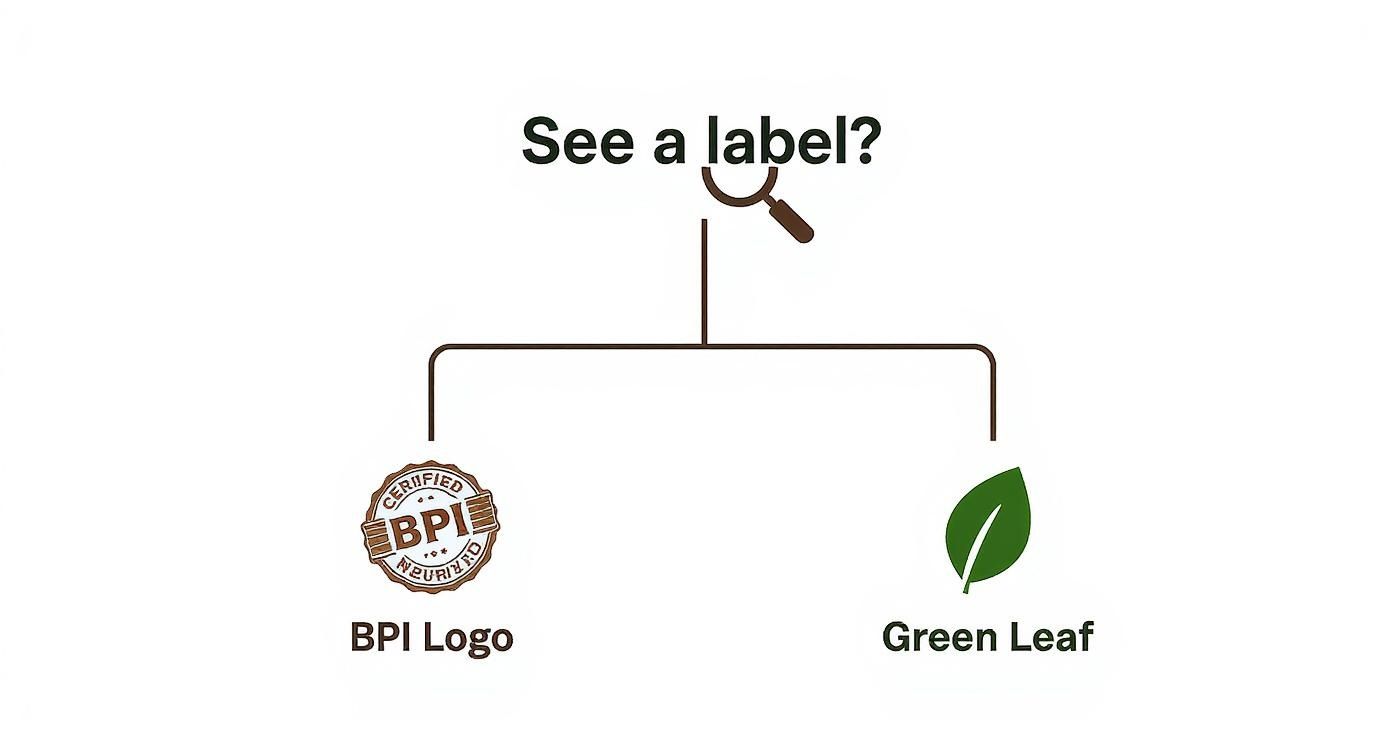
As the infographic makes painfully clear, only official certifications like the BPI logo guarantee a product is compostable. Vague "green" claims mean nothing without the proof to back them up.
The Disposal Dilemma of Biodegradable Bags
For bags labeled only as "biodegradable," the disposal path is a dead end. There is no designated system for them, which means they are almost guaranteed to end up in the worst possible place.
With no special instructions, "biodegradable" bags are thrown in the trash. This sends them straight to a landfill, where conditions are all wrong. Trapped without oxygen, they fail to decompose and can fragment into stubborn microplastics, rendering the "biodegradable" label meaningless in the real world.
The demand for real sustainable options is surging. The global compostable packaging market, valued at USD 76.81 billion, is projected to hit USD 120.14 billion by 2032. Compostable bags alone command nearly 40% of that market, a clear signal that consumers are demanding better alternatives.
Making Disposal Work for You
So, what can you do to get it right? Your power lies in knowing what’s available in your community.
- Investigate Local Composting Programs: Before buying compostable bags, find out if your municipality has a curbside green bin program that accepts them. Many do, but some have strict rules—Portland, for instance, only allows BPI-certified bags from commercial users, not residents. Always check local guidelines first.
- Find a Drop-Off Facility: No curbside service? Search for a nearby commercial composting facility that accepts public drop-offs.
- Consider Home Composting Carefully: While industrial composting is the gold standard, some bags are certified for home compost piles. But you must manage your pile diligently for it to work. For more on this, check out our guide on how to compost at home.
In the end, your ability to dispose of a bag correctly is the single most important factor. If you don't have access to a commercial facility, a certified compostable bag offers no real benefit over a regular plastic one—and a "biodegradable" bag is almost certainly worse.
Making the Right Choice for Your Needs
Knowing the science is one thing; applying it to your life is another. This isn't about finding one "perfect" bag. It's about matching the right product to your reality—and that reality is defined entirely by how you can get rid of it.
Making the right choice means you are actively helping the environment, not just accidentally creating a different kind of pollution. Let's walk through common scenarios to see which bag makes sense.
When to Choose Certified Compostable Bags
Certified compostable bags are specialists, designed for one mission only: to break down in a high-heat, professionally managed composting facility. They are unquestionably the superior choice, but only if you can get them to the right place.
Think of them as a vital tool in a modern organics recycling system. Here’s where they are invaluable:
- Lining Your Kitchen Food Scrap Pail: If your municipality has a green bin program for food scraps, a BPI-certified compostable bag is a game-changer. It eliminates the "ick factor" from your countertop bin and allows you to toss the entire thing—bag and all—into your municipal compost cart.
- Bagging Up Yard Trimmings: Many local yard waste programs are equipped to handle certified compostable bags. They are perfect for collecting leaves and grass clippings, ensuring both the bag and its contents become rich compost. Just confirm your local rules first; some programs still require paper bags or loose waste.
A certified compostable bag is a brilliant tool for diverting organic waste from landfills. But its success is 100% dependent on being sent to an industrial composting facility. If it doesn't end up there, its environmental benefits are completely nullified.
The Questionable Case for "Biodegradable" Bags
So, where do bags simply labeled "biodegradable" fit in? Honestly, they don't. There is almost no situation where they are the responsible choice. The term is unregulated and offers no guarantee that the bag will break down in any meaningful way or timeframe.
Most of these bags end up in landfills, where the lack of oxygen means they either mummify for centuries or break down anaerobically, releasing potent methane gas. More often than not, "biodegradable" is a feel-good marketing lie that delivers no real environmental benefit.
Still, the push for greener options is powerful. The global market for compostable and biodegradable refuse bags was valued at USD 341.5 million and is expected to hit USD 366.5 million. Bags between 7 and 20 gallons are the most popular, making up over 42% of sales—the perfect size for kitchen bins where people are desperately trying to do the right thing. If you're interested in market trends, you can discover more insights on the refuse bag industry from Future Market Insights.
This demand shows just how critical it is to choose products that actually deliver on their promises. When it comes to compostable vs. biodegradable bags, certified compostable is the undisputed winner—but only if you have the system to support it. If you don't, your best move is to focus on using fewer bags in the first place.
The Final Verdict: Which Bag Is Truly Better?
After examining the science, the certifications, and the real-world consequences, the compostable vs. biodegradable debate comes down to one decisive question: what can you do with it where you live? There is a clear winner, but its victory is conditional. The right choice depends entirely on your local infrastructure.
Let’s be unequivocal. A certified compostable bag is the superior environmental option, full stop—if, and only if, you can dispose of it correctly. It is designed for a perfect, circular journey, transforming from a useful product back into life-giving soil.
The Deciding Factor: Your Local System
The magic of a compostable bag is unlocked only in an industrial composting facility. These bags are engineered to break down in the high-heat, controlled environment these sites provide. If you have a municipal green bin program that accepts them, or a commercial facility you can access, then certified compostable bags are the clear and only responsible choice.
But here is the crucial catch: if you lack access to such a facility, all those benefits vanish into thin air. A compostable bag in a landfill is no better than regular plastic. In fact, by releasing methane as it decomposes anaerobically, it can be even worse for the climate.
The final verdict is conditional. Certified compostable bags are the best choice, but only if you have a guaranteed way to get them to a commercial composting facility. Without that pathway, their purpose is defeated.
A Strong Warning Against "Biodegradable"
So, where does that leave bags labeled "biodegradable"? Our advice is simple: avoid them. The term is so vague and unregulated that it has become a primary tool of greenwashing. It preys on your good intentions, making you feel like you're helping the planet without delivering any real benefits.
These bags almost never break down as you imagine. Instead, they often crumble into microplastics or languish in landfills for decades, just like conventional plastic. Their misleading claims do more harm than good, contributing to pollution while hiding behind a false green promise.
If you don't have access to commercial composting, what should you do? The most powerful action is to focus on reducing and reusing. Invest in sturdy reusable bags for groceries and daily errands. Cutting down on single-use items is the most reliable way to make a difference, regardless of your local disposal options.
Frequently Asked Questions
Knowing the definitions is one thing, but real-world choices are another. Let's tackle the most common questions that arise when you’re trying to do the right thing.
This is your practical guide to eliminating any final confusion, so you can act with confidence.
Can You Put Compostable Bags in a Regular Trash Can?
You can, but you shouldn't. Doing so completely negates their purpose. A compostable bag in the trash goes straight to a landfill, an oxygen-starved environment where it cannot break down as designed.
Instead of turning into healthy soil, the bag will decompose anaerobically (without oxygen). This process releases methane, a greenhouse gas far more destructive than carbon dioxide, turning an intended solution into a climate problem. These bags must go to a commercial composting facility to work.
Do Biodegradable Bags Break Down in Water?
This is a dangerous and widespread myth. The vast majority of products labeled "biodegradable" will absolutely not break down in the ocean or a lake. Instead, they become a menace, crumbling into smaller and smaller microplastics that poison fish, marine mammals, and the entire aquatic food web.
Unless a product has a rare and specific certification for marine degradation, the "biodegradable" claim is meaningless once it enters the water.
Are All Plant-Based Bags Compostable?
No. This is a critical distinction. "Plant-based" is a marketing term that only tells you what a bag is made from, not what happens to it at the end of its life. While many compostable bags use starches from corn or potatoes, a bag can be made from plants and still not be compostable.
The only way to be certain is to look for the certification. The BPI Certified Compostable logo is your proof that the bag has passed the rigorous ASTM D6400 standards. Without that seal, "plant-based" is just a story, not a solution.
Where a bag comes from is a nice story. Where it can safely go is what really matters. Certification is the only guarantee it will turn back into soil.
Why Do Some Cities Ban Compostable Bags in Green Bins?
This can feel incredibly frustrating, but it stems from the operational challenges at composting facilities. Some sites lack the technology to easily distinguish between a certified compostable bag and a regular plastic one, and even a small amount of plastic contamination can ruin tons of compost.
For instance, Portland, Oregon, has rules allowing BPI-certified bags from businesses but not from residential green bins to maintain the purity of their compost. Other facilities might not be equipped to handle bioplastics at all. This is why it is absolutely critical to check your local city or county guidelines before tossing any "compostable" product in your green bin. Following their rules is the only way to ensure the system works for everyone.
Ready to choose a bag that truly closes the loop? With terravera, you get BPI-certified compostable bags designed to break down properly in a commercial facility, turning your waste into a valuable resource. Make a choice that counts for the planet. Learn more and shop our collection at https://www.myterravera.com.