

BPI Certified Compostable Bags: Your Complete Guide to Making a Real Difference
In a world flooded with "green" claims, it's easy to feel lost. But when it comes to compostable bags, one seal cuts through the noise and guarantees you're making a genuine impact: BPI certified. This isn't just another logo; it's the gold standard, a scientifically-backed promise that your bag will break down into healthy, life-giving soil in a commercial composting facility.
Think of the BPI seal as a trusted passport. It's your assurance that a product has passed the strictest tests and is ready to join the circular economy, transforming our waste from a problem into a solution. Choosing BPI is choosing with confidence.
Decoding BPI Certification: The Mark of True Sustainability
Let’s be honest—navigating sustainability claims is a minefield. Vague words like "biodegradable" and "eco-friendly" are thrown around so freely they've become almost meaningless. This is precisely why the Biodegradable Products Institute (BPI) exists: to bring scientific certainty to a world of empty promises.
BPI certification is not a marketing gimmick. It's an exhaustive, third-party verification process. When you see that seal, you are looking at proof. It means the product has endured rigorous scientific testing and will break down completely and safely, leaving nothing harmful behind. It is your single best defense against misleading "greenwashing."
What Does The Certification Guarantee?
A BPI certified compostable bag is engineered to be processed in an industrial composting facility, seamlessly returning to the earth alongside food scraps and yard trimmings. The certification is an ironclad guarantee that the bag meets three non-negotiable standards:
- Disintegrates Rapidly: The bag must vanish into tiny, non-visible pieces within a strict timeframe, just like an apple core or banana peel disappears into the soil.
- Biodegrades Completely: After breaking apart, microorganisms must fully consume the material, converting it into carbon dioxide, water, and biomass. No microplastics or toxic residues are left behind. Ever.
- Produces Safe, Rich Compost: The final compost is rigorously tested for heavy metals and other pollutants to ensure it’s not only safe but beneficial for gardens and farms. It has to be clean enough to help grow the food of tomorrow.
This meticulous process ensures the bag doesn't just disappear—it actively contributes to a healthier planet, transforming waste into a valuable resource.
By transforming food scraps and certified compostable packaging into valuable soil amendments, we create green jobs and foster resilient, thriving communities. This system turns everyday waste from a liability into an asset.
BPI Certified vs. Deceptive "Green" Bags
The difference between a BPI certified bag and its imitators is the difference between a real solution and a hidden problem. This table makes the choice crystal clear.
| Bag Type | The Hard Truth | End-of-Life Reality | Third-Party Verification |
|---|---|---|---|
| BPI Certified Compostable | Breaks down completely into non-toxic components in a commercial facility. A true circular solution. | Commercial composting. | Yes, certified by BPI. |
| "Biodegradable" | Will break down eventually, but could take centuries and likely leaves behind microplastics. | Almost always ends up in a landfill. | No, a meaningless and unverified claim. |
| "Eco-Friendly" / "Green" | A vague marketing term with zero defined standards. It means nothing. | Usually landfill. | No, it's just marketing fluff. |
| Oxo-Degradable | Plastic with additives that make it fragment into countless microplastics. A genuine environmental hazard. | Landfill, where it actively creates plastic pollution. | No, and it's banned in many regions for good reason. |
Don't be fooled by clever marketing. Demand the BPI logo—it cuts through the noise and proves you’re getting the real deal.
Why This is Your Power as a Consumer
Choosing BPI certified products is a direct vote for a healthier planet. It eliminates the guesswork, empowering you to know with certainty that you are not accidentally contaminating a compost bin with the wrong material.
This is especially critical for specific uses, like collecting pet waste. If you're serious about this topic, this ultimate guide to compostable poop bags for dogs is an invaluable resource. Ultimately, the BPI seal allows you to participate in a circular system where organic waste gets a second life as nutrient-rich soil. It's a choice you can truly feel good about.
The Uncompromising Science Behind BPI Certification
That BPI logo on a compostable bag represents more than just a claim—it's a stamp of scientific integrity. To earn it, a product must survive a grueling, evidence-based process that proves it will genuinely help, not harm, the composting cycle. This is a profound scientific examination based on standards recognized across the globe.
In North America, the unshakeable standard for compostable plastics is ASTM D6400. This is the official rulebook. It outlines a series of unforgiving tests a product must pass to prove it can break down safely and completely in an industrial composting facility, where conditions are optimized for decomposition.
The Three Pillars of BPI Testing
For a BPI certified compostable bag to meet the ASTM D6400 standard, it must conquer three non-negotiable tests. Each one scrutinizes a different stage of the composting journey, from the bag's initial breakdown to the final quality of the compost it helps create.
-
Disintegration (Breaking Apart): First, the bag must physically disintegrate. In a controlled composting environment, at least 90% of the bag must break into pieces smaller than 2 millimeters within just 84 days. At this stage, it should be visually indistinguishable from the surrounding compost.
-
Biodegradation (Being Consumed): This is where nature takes over. The test measures how much of the bag's carbon is converted into carbon dioxide by hungry microbes. To pass, a staggering 90% of the material must biodegrade within 180 days. This is the ultimate proof that microorganisms are truly consuming it, leaving zero plastic fragments behind.
-
Eco-toxicity (Ensuring Safety): Finally, the end product must be proven safe for the earth. The resulting compost is tested for heavy metals and any other potentially harmful substances. To pass, the compost must demonstrate it can support healthy plant life—the definitive confirmation that the bag leached no toxins into the soil.
This entire journey—from physical breakdown to microbial digestion and a final safety check—is the unwavering promise of BPI certification.
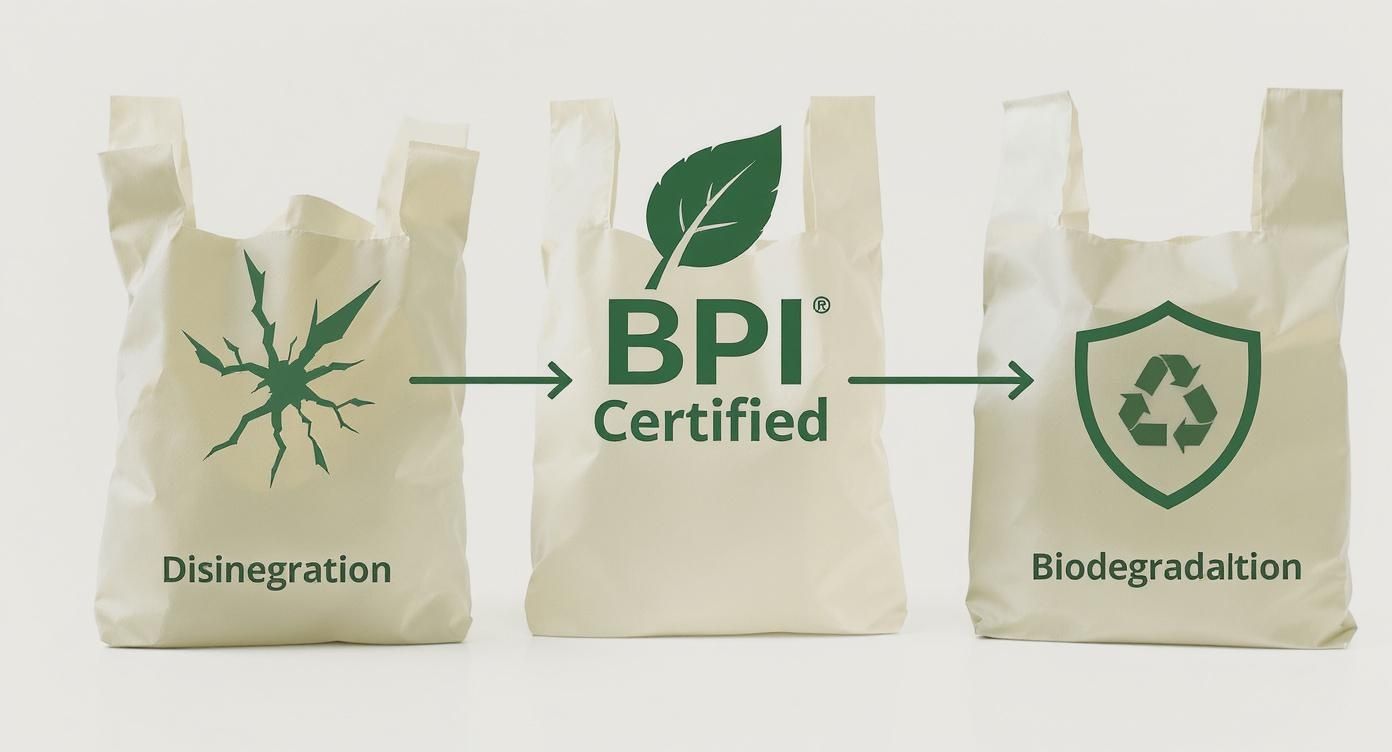
As you can see, the process ensures a complete and clean cycle, turning a potential waste product back into a valuable resource for the earth.
Why This Rigorous Process Builds Unbreakable Trust
This demanding, three-stage testing is what separates genuinely compostable products from the pretenders. It establishes a clear, scientific benchmark that leaves no room for greenwashing. The materials themselves are, of course, a huge part of this success, and you can learn more about what compostable bags are made of in our other guide.
When you see that BPI seal, you can feel confident that the product has been put through its paces. You know it’s part of a real solution for turning our food scraps and other organic waste into something that helps replenish the soil. It's science you can trust.
How to Spot and Verify Genuine BPI Certified Bags
With so many products trying to look "green," it's easy to be misled. But you have the power to see through the deception. Verifying a genuinely BPI certified compostable bag is simple once you know what to look for.
Your first move? Look for the official BPI Certification Mark directly on the product or its packaging. Don't be fooled by imitation symbols or empty phrases like "100% compostable" if they aren't backed by the official BPI seal. These are classic red flags for greenwashing—a tactic used by companies to appear more sustainable than they truly are.
Demand the Official BPI Logo
The BPI Certification Mark is your most reliable signal of authenticity. You might see a couple of versions, one for the US and one for Canada, but both signify that the product has passed the same tough testing standards.
- The BPI Compostable Logo: This is the mark of a true performer. It clearly states "COMPOSTABLE" and must include a unique certification number.
- Unique Certification Number: Every single product that earns BPI certification is assigned a unique number. This isn't just a detail; it's your key to absolute verification.
A product without the BPI Certification Mark printed directly on it or its packaging has not been certified by BPI. Relying on the logo is the quickest way to filter out unverified and potentially misleading products on the shelf.
Use the BPI Certified Product Catalog for Final Proof
While the logo is a great start, the foolproof method to confirm a product's legitimacy is to check the official BPI Certified Product Catalog online. This database is the ultimate source of truth. If a product isn't listed here, it is not BPI certified—no matter what the package claims.

Use their powerful search tool to look up a product by company name, product line, or the certification number you found on the package. This will instantly confirm if the product is the real deal. This verification is crucial because it answers the bigger question: are compostable bags really compostable? Our guide on that topic provides even more context.
Taking a moment to perform this quick check is your most powerful move as a conscious consumer. It cuts through marketing fluff and ensures your choices genuinely support a circular economy where products break down as promised.
The Benefits and Limitations: A Clear-Eyed View
To make the best choices for our planet, we need the whole story. While BPI certified compostable bags offer a powerful environmental advantage, it's vital to understand their limitations. A balanced view is the only way to ensure you’re using them effectively and creating the positive impact you intend.
The single greatest benefit is diverting food scraps from landfills. When organic waste is buried in a landfill, it decomposes without oxygen, releasing methane—a greenhouse gas far more destructive than carbon dioxide. By using BPI certified bags to send your food scraps to a commercial composter, you are directly fighting climate change. Even better, this process transforms "waste" into a precious resource: nutrient-rich compost that revitalizes our soil and reduces the need for chemical fertilizers.
The Power of Choosing Certified Products
This isn't just a niche movement; it's a global shift. The compostable bags market is already valued at around $4 billion and is projected to grow at an explosive 15% annually. You can read more about the compostable bags market growth on kimecopak.ca.
This surge is driven by people like you demanding better alternatives to traditional plastic. When you choose products with the BPI seal, you are fueling this positive change and helping build a circular system where organic waste is returned to the earth.
Understanding the Critical Limitations
Here’s the reality check: these bags are not a magic bullet for plastic pollution. Their entire environmental promise is tied to a very specific disposal process.
The crucial takeaway is that BPI certified compostable bags are designed exclusively for industrial composting facilities. They are not meant for your backyard compost bin, nor will they break down if littered in the environment.
Industrial facilities are highly controlled environments. They create the perfect storm of intense heat, moisture, and microbial activity needed to decompose these bags quickly and safely. Without those exact conditions, they simply will not work as intended.
For instance, your backyard compost pile rarely gets hot enough to fully break down the bioplastics used in these bags. Toss one in, and you’ll likely find a slimy, degraded bag months later. And if one ends up in a landfill, it can't break down properly, and all its potential benefits are lost. Proper disposal isn't just a suggestion; it is the key that unlocks their environmental purpose.
How to Properly Dispose of Compostable Bags
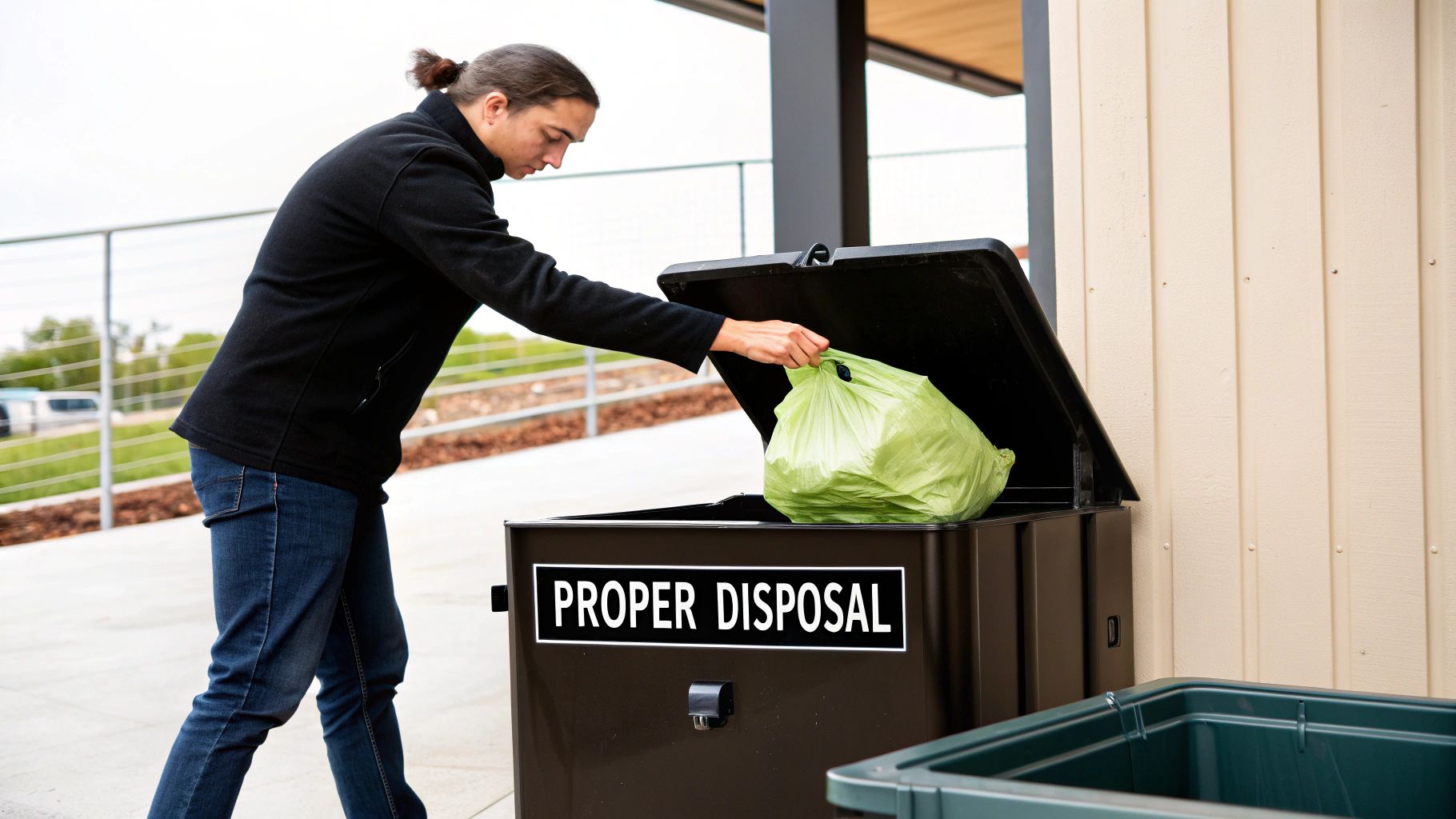
Choosing a BPI certified compostable bag is a fantastic start, but your final action is what truly makes the difference. Proper disposal is the critical step that closes the loop, turning your food scraps and the bag itself back into a valuable resource for the soil.
These bags are engineered to break down in the hot, active environment of a commercial composting facility. Think of it as a specific recipe—they need just the right conditions to decompose, and only industrial composters have perfected that recipe.
Finding the Right Home for Your Bags
The most important thing you can do is ensure your bags end up in an industrial or commercial composting program that accepts them. Tossing them in the wrong bin can create more problems than it solves, so a few moments of research is an investment in our planet's future.
Here’s how to find the right destination for your bags:
- Check Your City's Waste Management Website: This is your best first stop. Look for their guidelines on "organics" or "compost collection" to confirm that BPI certified bags are on their list of accepted items.
- Use Online Search Tools: A quick search for "commercial composting near me" is a great way to find local facilities or drop-off locations.
- Contact Private Haulers: If your city lacks a curbside program, private composting services are becoming increasingly common. They provide a bin and handle the pickups, making it incredibly easy to do the right thing.
This is a global movement. In Europe, where regulations have spurred a major shift from traditional plastics, the market for these bags was valued at $341.5 million and is projected to hit $756.3 million by 2035. This growth is driven by a collective commitment to smarter waste systems.
Common Disposal Mistakes to Avoid
Knowing where not to put your compostable bags is just as important as knowing where they belong. A few common mistakes can completely negate their environmental benefits.
Remember, a compostable bag in the wrong environment is just another piece of trash. It needs the right conditions to fulfill its eco-friendly promise.
Make sure to keep your certified bags out of these three places:
- The Recycling Bin: Compostable bags are contaminants in the plastic recycling stream. Made from different materials, they can ruin an entire batch of otherwise valuable recyclable plastic.
- The Landfill: Buried in a landfill without oxygen, these bags can't decompose as designed. Instead, they may release methane, a potent greenhouse gas, defeating the entire purpose of choosing them.
- Your Backyard Compost: While home composting is a fantastic practice, most backyard piles simply don't get hot enough for long enough to break down BPI certified bioplastics. For tips on managing a home system, check out our guide on https://myterravera.com/blogs/news/how-to-compost-at-home. To make sure your BPI certified bags break down properly, it helps to understand the different composting setups available, and you can explore various compost designs to learn more.
Common Questions About BPI Certified Bags
Even with all the science and standards, it's natural to have questions. Let's tackle some of the most common ones to eliminate any confusion and empower you to choose and use the right bags for your organic waste with total confidence.
Getting these answers right is the key to bridging the gap between buying a sustainable product and actually making a sustainable impact.
Are Biodegradable and Compostable the Same Thing?
This is the most common point of confusion, and the answer is an emphatic no. These terms are absolutely not interchangeable, and the difference is critical.
"Biodegradable" is a vague, unregulated marketing term. It simply means something will eventually break down, but that could take decades and leave toxic microplastics behind.
In stark contrast, "compostable" is a precise, scientific standard. It is a guarantee that a product will break down into natural, non-toxic elements within a specific timeframe and under specific conditions. A BPI certified compostable bag has been proven to do exactly that, becoming healthy soil instead of pollution.
Can I Use BPI Certified Bags in My Backyard Compost?
It's a great question, but the answer is generally no. BPI certification is specifically for the high-heat environment of a commercial or industrial composting facility. These large-scale operations maintain temperatures of 131°F (55°C) or higher, which is essential for breaking down these materials correctly.
Your backyard compost pile simply does not get that hot for that long.
Without the intense, sustained heat and microbial activity of a commercial facility, a BPI certified bag will break down incredibly slowly in a home compost bin, if it breaks down at all. For the best results, always send them to a program that's equipped to handle them.
This distinction is vital if you want the bag to fulfill its environmental promise.
What Happens if a Compostable Bag Ends Up in a Landfill?
This is the worst-case scenario. When a BPI certified bag is sent to a landfill, it gets buried under tons of trash, cutting it off from the oxygen it needs to decompose correctly.
In that oxygen-starved environment, it breaks down anaerobically. This process releases methane, a greenhouse gas far more potent than carbon dioxide. The bag's incredible potential to create nutrient-rich compost is completely wasted, and it may even contribute to climate change.
Why Do Some Composting Programs Not Accept Them?
While acceptance is growing rapidly, some facilities remain hesitant. The primary reason is contamination. When people accidentally toss regular plastic bags into the compost bin, it can ruin an entire batch of finished compost.
Facilities must be confident they can filter out the non-compostable imposters. As more people learn how to identify and correctly dispose of BPI certified compostable bags, acceptance will continue to grow. Supporting brands with clear, unmistakable labeling helps accelerate this positive change.
Ready to make a confident, sustainable choice? terravera offers a full line of BPI certified compostable bags designed to work seamlessly with commercial composting programs, helping you turn your food scraps into a valuable resource. Make your purchase count by exploring our products today.